


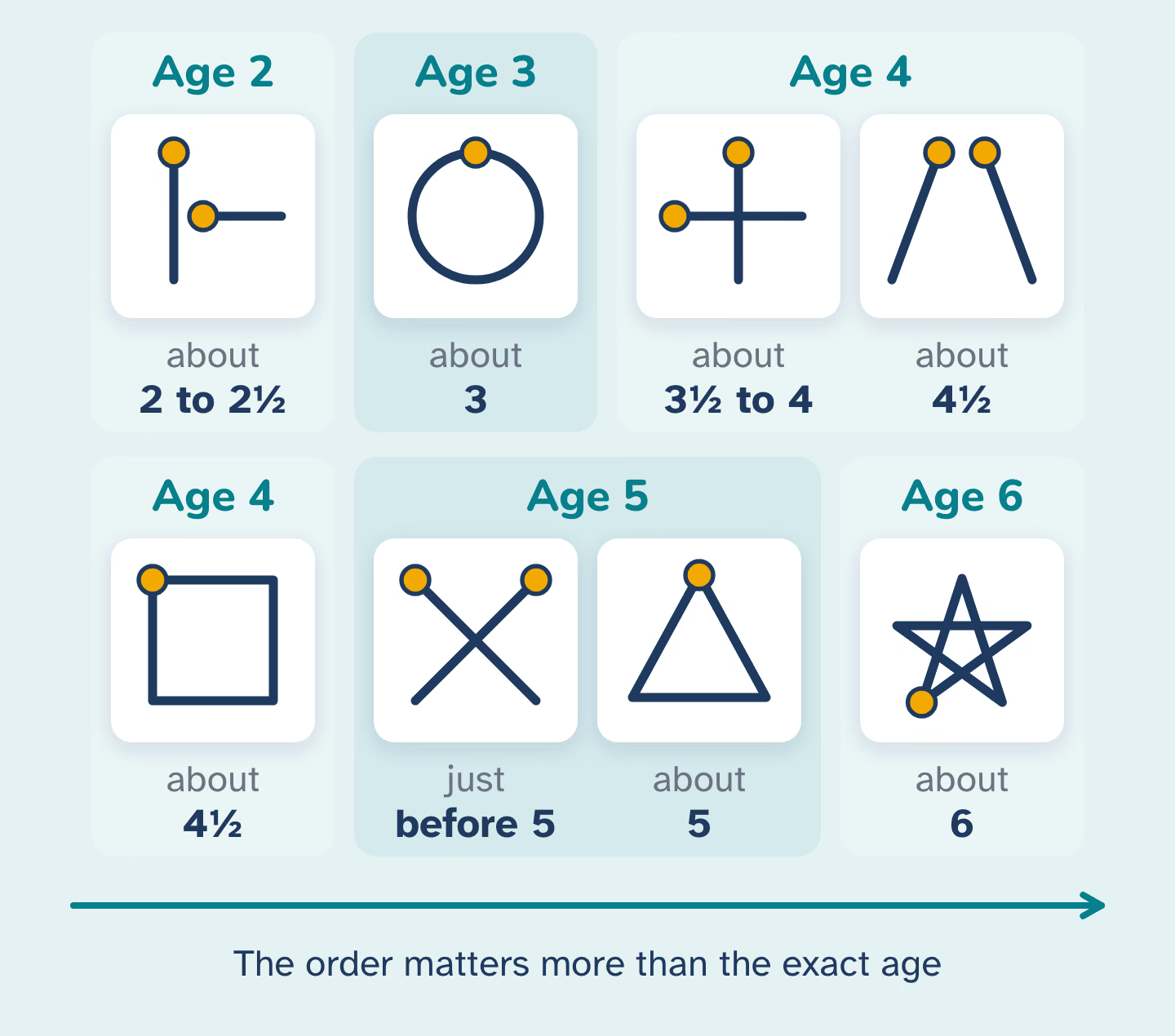
Many children are ready to follow a big dashed line at about three, once they can draw a straight line right after watching you. From there, a rough plan for tracing worksheets by age is circles at three; crosses, slants and squares at four; their name and other letters at four to five; and whole words from about six. The ages come from occupational therapy charts and shift by months either way, so choose by what your child can already do rather than their birthday, and keep sessions short.
Tracing worksheets by age at a glance
The ages come from children’s occupational therapy (OT) charts from the NHS and the American Occupational Therapy Association (AOTA), and from CDC milestones. Every maker linked below is free, with no sign-up, and prints on US Letter or A4.
| About age | Many children can | What to trace | Session |
|---|---|---|---|
| 2 | Scribble, and draw a line right after watching you | Big lines with a finger; big pictures to color | 1 to 2 minutes |
| 3 | Copy up-and-down and side-to-side lines; draw a circle when shown | Lines and circles, one to a page; simple pictures | A few minutes |
| 4 | Copy a cross; hold a crayon in the fingers rather than a fist | Crosses, slants and squares; the first letters of their name | About 5 minutes |
| 5 | Copy an X and a triangle; write some or all of their name | Their name, letters, numbers 0 to 20 | 5 to 10 minutes |
| 6 | Copy a star; print most letters | Words, days of the week, their last name | 10 to 15 minutes |
Read every age as “about.” CDC milestones are things 75% or more of children can do by that age, and the Solihull Children’s Occupational Therapy Service calls its chart a guide only: practice, family expectations and a child’s own motivation all play a part.
About age 2: scribbles and big lines
Two-year-olds scribble, gripping the crayon in the whole hand; the CDC lists scribbling by 18 months. Straight lines come next. The children’s OT team at York and Scarborough Teaching Hospitals says that at two to two and a half, children imitate up-and-down and side-to-side strokes an adult has just drawn, and the AOTA chart puts copying them at about two to two and a half.
What to trace. Honestly, not much on paper. Tracing for toddlers works best with a finger: in sand, in shaving foam or along a fat line you draw. For tracing worksheets at this age, choose One big in the shape tracing maker and pick Up and down or Side to side. Your child can run a finger from the start dot, then try a chunky crayon. A large picture from the picture tracing maker makes a good coloring page, with the dashed outline as a loose guide rather than a target.
How long. A minute or two, for as long as they’re enjoying it.
Ready for more when they draw a line on purpose after watching you, and stop where they meant to.
About age 3: lines and circles
By three, many children copy straight lines both ways, and circles arrive about now. The CDC’s list for three-year-olds includes “draws a circle, when you show him how,” and the Solihull and AOTA charts both put copying a circle at around three. The Aneurin Bevan children’s OT service in Wales links tracing dotted lines with the four-finger grip, the stage after holding the crayon with all fingers and the palm facing down.
What to trace. This is the stage most tracing worksheets for 3-year-olds are really for: straight lines, circles and simple pictures, all large. In the shape maker, choose One big and pick Up and down, Side to side, Circles or the Circle shape; every pre-writing line has a dot where the pencil starts. In the picture maker, try simple pictures such as a ball, a balloon or an apple, with Word under each picture turned off.
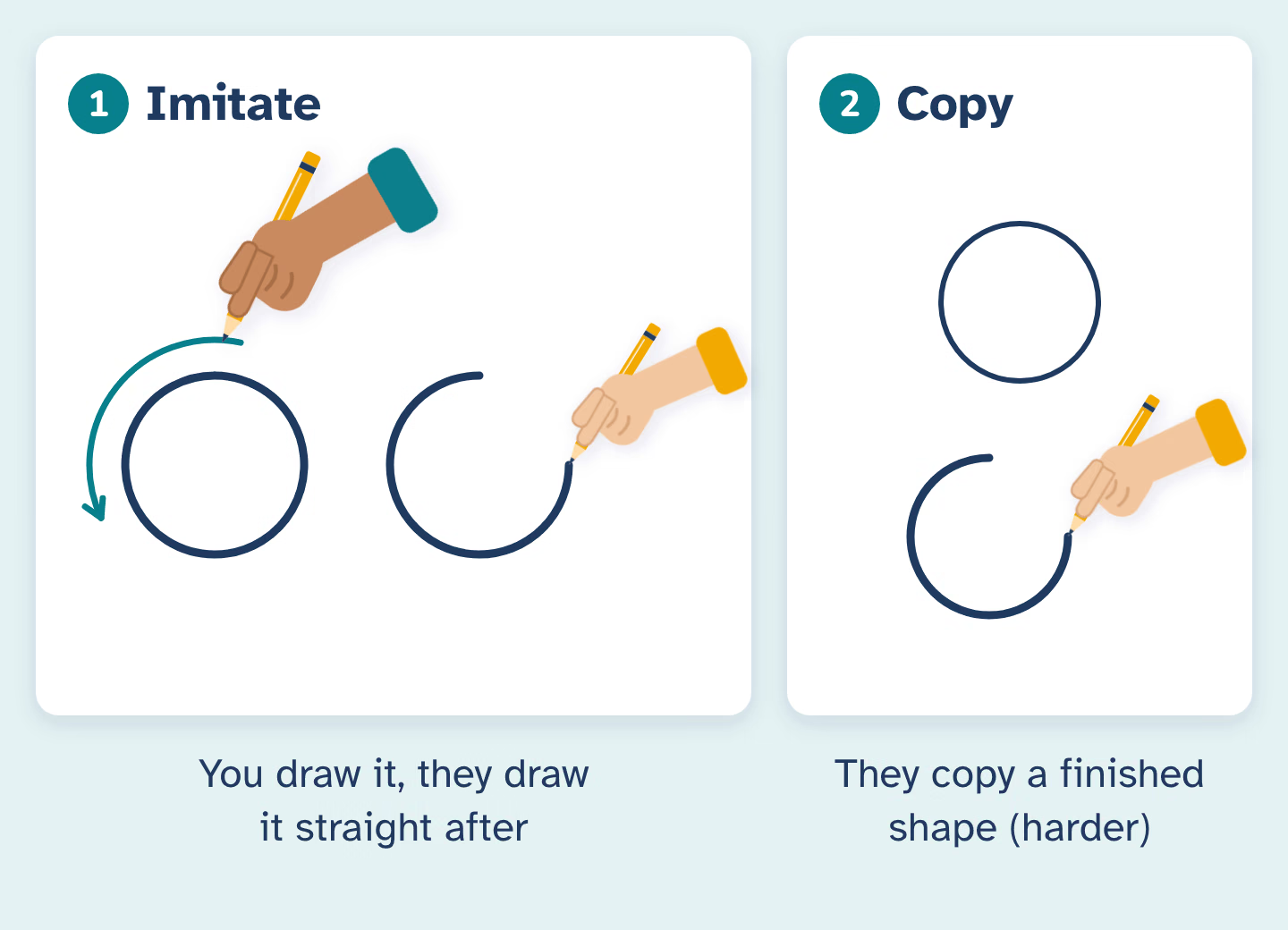
Draw each one yourself first. North Cheshire and Mersey’s children’s OT service explains that imitating a shape you’ve just drawn is easier than copying a finished one, and that a child who can’t yet imitate a shape shouldn’t be expected to copy it.
How long. A few minutes: one page, or one line traced a few times.
Ready for more when they draw a circle that closes up, and follow a dashed line most of the way without drifting off it. Our pre-writing shapes guide covers the order in detail.
About age 4: crosses, slants and a first letter
A cross (+) usually comes at about three and a half to four, then slanted lines and a square at around four and a half; York’s team groups these at four to four and a half. Grip changes too. The CDC lists holding a crayon or pencil between the fingers and thumb, not in a fist, by four, and the AOTA chart places the first three-finger grip at about three to four. Our pencil grip guide explains the stages.
In a study of 372 Florida preschoolers, Cynthia Puranik and Christopher Lonigan found that about four in five four-year-olds wrote the first letter of their name, but fewer than half wrote the whole name correctly.
What to trace. Tracing worksheets for 4-year-olds can move on to Crosses, Slants and Zigzags, and the Square and Rectangle, at Two on a page once lines are steadier. When your child is curious about letters, start with their name in the name tracing maker, at Pre-K size, the largest, with a capital first letter and lowercase after. Names are made into pages on your device and never uploaded. Our guide to helping a child write their name has a five-minute routine.
How long. About five minutes, on most days rather than in one long session on the weekend.
Ready for more when they copy a cross and a square without the dashes, and start asking how to write letters.
About age 5: names, letters and numbers
The Solihull and AOTA charts put the X (diagonal cross) just before five and the triangle a little after. York’s team says five-year-olds start forming letters, especially those in their own name, and the CDC lists “writes some letters in her name” by five. In the Florida study, most five-year-olds wrote their whole name.
In the US, the Common Core standards ask kindergartners to print many upper- and lowercase letters and to write numbers from 0 to 20. The same first year of school is Kindergarten, Prep or Foundation in Australia, depending on the state, and Reception in England.
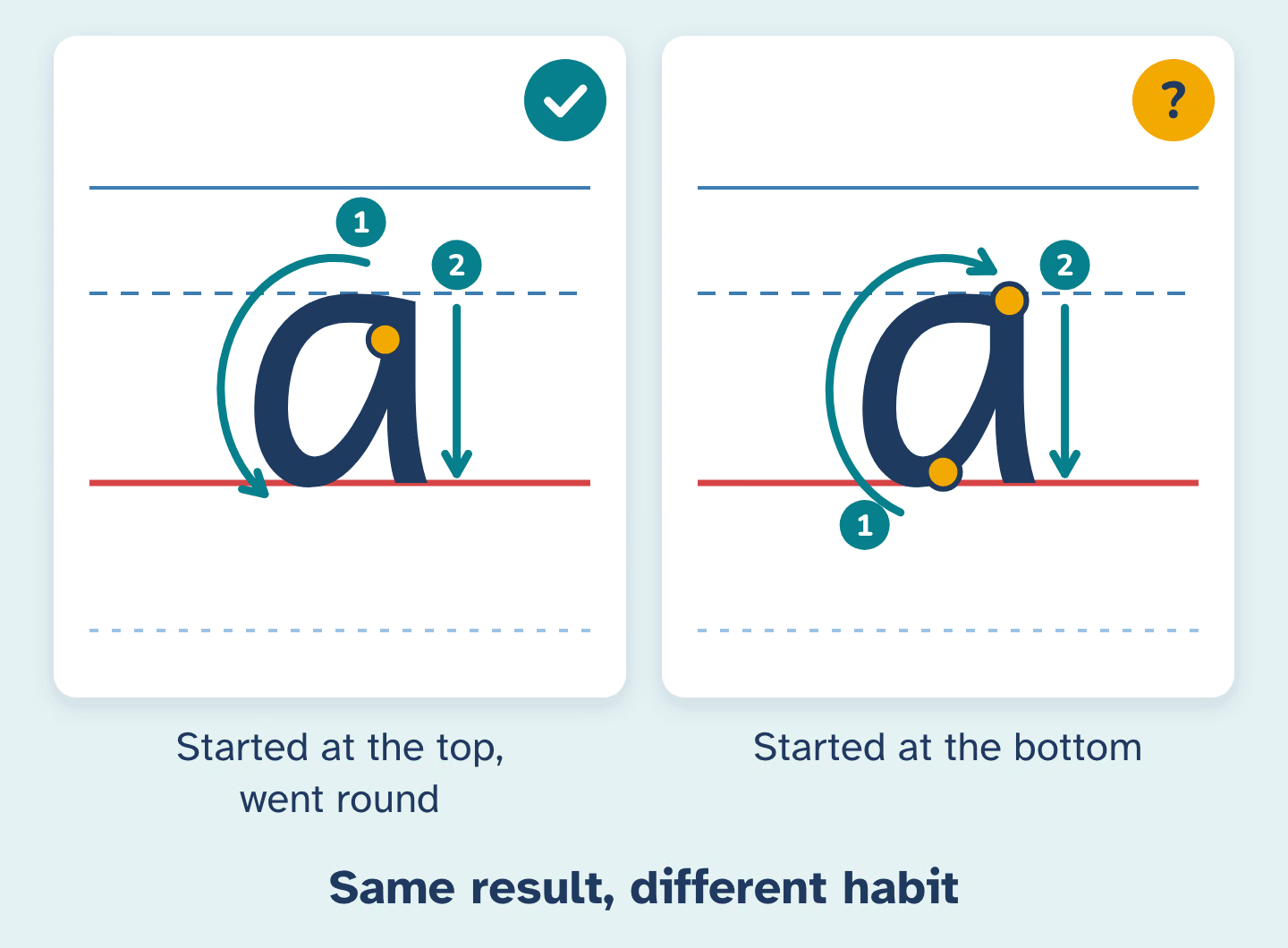
What to trace. Tracing worksheets for 5-year-olds center on their name, then letters a few at a time with the letter tracing maker, and numbers 0 to 10, then 1 to 20, with the number tracing maker. Each page has an example row, rows to trace and blank rows, in your school’s handwriting style, at Kindergarten size or Pre-K for a beginner. Watch where each letter starts: a letter traced from the bottom up can look perfect afterwards. Our guide to letter formation shows where each one begins.
How long. Five to ten minutes. The CDC lists paying attention for 5 to 10 minutes during activities such as arts and crafts among its milestones for five-year-olds, which makes a sensible ceiling for tracing worksheets at age five.
Ready for more when they write their name from memory, start most letters in the right place, and their blank rows look like the traced ones.
About age 6: words, and less tracing
From six, York’s team describes children drawing freely, copying a star and really developing their letter formation. The Common Core asks first graders to print all upper- and lowercase letters and to capitalize dates and people’s names. Grip is still settling: the Aneurin Bevan service says most children master the three-finger grip by six or seven.
What to trace. Whole words: sight words and three-letter words with the word tracing maker, the days of the week, each with its capital letter, and their last name once the first is secure. Number pages can stretch to 100. At this age, tracing worksheets work best as a warm-up: a row or two, then most of the time on the blank rows. Our guide to whether tracing worksheets help explains why writing from memory matters.
How long. Ten to fifteen minutes. Handwriting researcher Steve Graham recommends short sessions several times a week or daily from kindergarten to grade 3, and each lesson in his first-grade program takes 15 minutes.
Ready for more when letters come out right without a model. From then on, whatever their age, save tracing worksheets for new letters and new handwriting styles.
Then try missing letter and missing number sheets, which ask for each one from memory.
If it’s too hard, or too easy
The Solihull OT service talks about a “just right” challenge: one that stretches your child but stays within reach. Change the page rather than push through.
If it’s too hard:
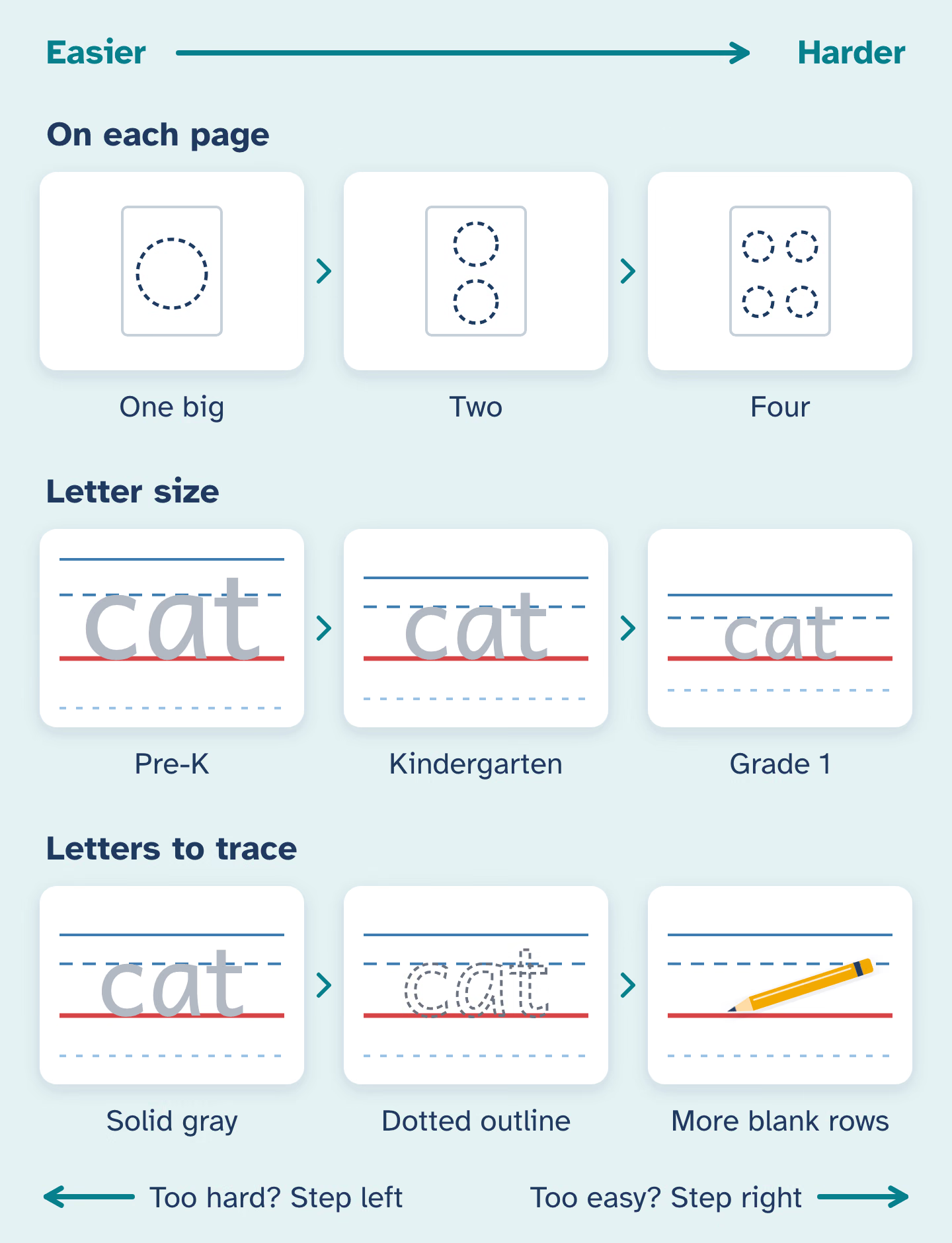
- Go back a stage. From letters to lines, from Four on a page to One big, from Grade 1 letter size to Pre-K.
- Finger first. The Royal Children’s Hospital in Melbourne suggests tracing lines and shapes with a finger before a pencil.
- Show it again, or lend a hand. Draw it while your child watches. Solihull also suggests your hand over or under theirs for a go, so they feel the movement.
- Do less. Half a page, then stop on a good one.
If it’s too easy:
- Fit more on a page. Two, then Four, or one letter size smaller.
- Give less help. Switch to dotted-outline letters, with fewer rows to trace and more blank rows.
- Add a free try. Ask for one of their own beside each traced shape or letter.
- Move to the next maker in the table above.
For letters, only the Queensland style can add start dots or arrows to the tracing rows. In every other style, show where each letter starts as you write the example row. If small hands tire quickly, our fine motor activities build strength away from the page.
It’s not a race: when to ask for help
Being a few months behind a chart is common, and more relaxed drawing time is often the first thing to try. It’s worth asking for advice, though, if your child:
- still can’t copy a circle or a cross by the time they start school, after plenty of relaxed practice
- avoids drawing and coloring, or gets very upset by it
- says their hand hurts, or presses so hard the paper tears
- seems to have lost a skill they used to have
The CDC’s advice is not to wait: talk with your child’s doctor and ask about developmental screening. Your child’s teacher can help too, and a pediatric occupational therapist can look at what is making drawing hard. York’s OT team lists delayed motor skills, coordination difficulties, low muscle tone, hypermobility and difficulty concentrating among the reasons children may need support.
Questions about tracing worksheets by age
What age can kids start tracing?
Many children can follow a large dashed line at about three, with a finger or a chunky crayon. Two-year-olds can join in with finger tracing and big, scribbly coloring, but staying on a printed line is a lot to ask before three.
When can a child trace letters, or their name?
Many start at around four, once lines, circles and crosses come fairly easily, usually with the letters of their own name. Most can write the whole name by about five, and kindergarten adds many more letters. If a three-year-old asks, start with the first letter. The Royal Children’s Hospital suggests showing your child how you write each letter, then letting them copy one letter at a time.
My four-year-old wants to write letters but can’t draw a cross yet. Should we wait?
Follow the interest, lightly. The Royal Children’s Hospital advises parents not to be too eager to teach letters, and the Aneurin Bevan service suggests moving on to letters once a child has mastered the pre-writing shapes and is interested. Trace the first letter of their name when they ask, and keep crosses and slants going alongside.
Sources
- Solihull Children’s Occupational Therapy Service, University Hospitals Birmingham NHS Foundation Trust: Pre-writing skills
- American Occupational Therapy Association, Children and Youth Special Interest Section: Pre-writing and handwriting skills infographic
- York and Scarborough Teaching Hospitals NHS Foundation Trust, Occupational Therapy: Mark-making, general advice
- Aneurin Bevan University Health Board, Occupational Therapy Service for Children and Young People: Development of a tripod pencil grip
- Aneurin Bevan University Health Board, Occupational Therapy Service for Children and Young People: Developing early writing skills
- North Cheshire and Mersey Occupational Therapy Service for Children and Young People: Pre-writing skills
- Royal Children’s Hospital Melbourne, Occupational Therapy: Prewriting skills and activity ideas
- Centers for Disease Control and Prevention, Milestones by 18 months
- Centers for Disease Control and Prevention, Milestones by 3 years
- Centers for Disease Control and Prevention, Milestones by 4 years
- Centers for Disease Control and Prevention, Milestones by 5 years
- Puranik and Lonigan, “From scribbles to scrabble: Preschool children’s developing knowledge of written language”, Reading and Writing (2011)
- Common Core State Standards Initiative: Language, Kindergarten
- Common Core State Standards Initiative: Language, Grade 1
- Common Core State Standards Initiative: Kindergarten, Counting and Cardinality
- Steve Graham, “Want to improve children’s writing? Don’t neglect their handwriting”, American Educator (2009/10)


