


Pre-writing shapes are the basic strokes that letters and numbers are built from: vertical and horizontal lines, circles, crosses, diagonal lines, squares, X shapes and triangles. Children usually learn to copy them in roughly that order, starting at about two and finishing a little after five. They matter because, as one NHS children’s occupational therapy service puts it, these are the pencil strokes that most letters, numbers and early drawings are made of.
The pre-writing shapes, in the order children usually master them
Two occupational therapy charts set out the same sequence with very similar ages: a handout from the Solihull Children’s Occupational Therapy Service in England, and an infographic from the Children and Youth Special Interest Section of the American Occupational Therapy Association. The ages below are for copying a shape, and they are approximate.
- Vertical line, top to bottom: from about two to three.
- Horizontal line, left to right: around two and a half to three.
- Circle: around three.
- Cross (+): around three and a half to four.
- Diagonal lines: around four and a half. Both charts put one slant a few months before the other, but they disagree about which one comes first.
- Square: around four and a half.
- X (diagonal cross): just before five.
- Triangle: a little after five.
Before all of this comes scribbling, which the Solihull chart places at one to two years. Other services describe the same general order. NHS Fife’s children’s OT team says children draw vertical and horizontal lines first, then circles, crosses and diagonal lines, and finally squares and triangles. The Royal Children’s Hospital in Melbourne suggests starting with horizontal and vertical lines and moving on to a circle, a square and a triangle.
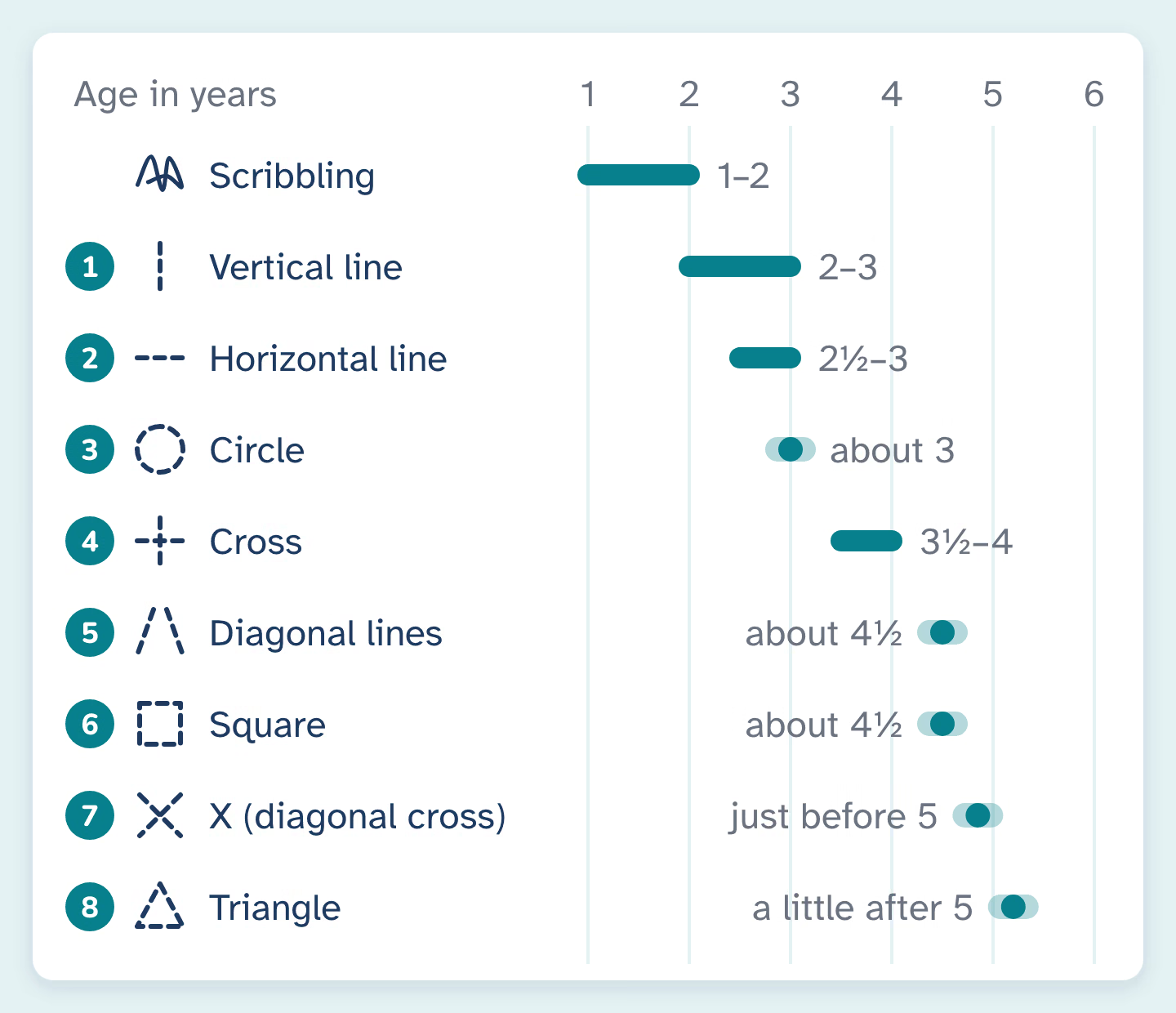
Treat the ages as a guide, not a test. The Solihull handout says plainly that how a child develops these skills depends heavily on their experience and opportunities to practise, on family and cultural expectations, and on the child’s own choices and motivation. A child who has drawn every day since they could hold a crayon will often be ahead. A child who has had fewer chances to draw may simply need more of them.
Why the order makes sense
Each shape adds one new demand to the one before. A vertical or horizontal line is a single movement in a single direction. A circle asks the hand to change direction smoothly all the way round and finish where it started. A cross needs two lines that meet in the right place. A diagonal has no edge of the page to follow, so the child has to aim. A square brings sharp stops and turns at the corners. The X combines two diagonals that must cross in the middle, and the triangle joins slants going in opposite directions at three corners.
Pre-writing shapes also develop alongside pencil grip. The children’s OT service at Aneurin Bevan University Health Board in Wales links the two. At the stage where a child holds the crayon with all fingers and the palm facing down, they start to copy horizontal, vertical and circular lines. With a four-finger grip they can imitate zigzags and crossed lines and trace dotted lines. By the time they hold the pencil with three fingers, they can copy a diagonal line, a square, a diagonal cross, a circle and a triangle. Our pencil grip guide covers those stages in detail.
How pre-writing shapes turn into letters
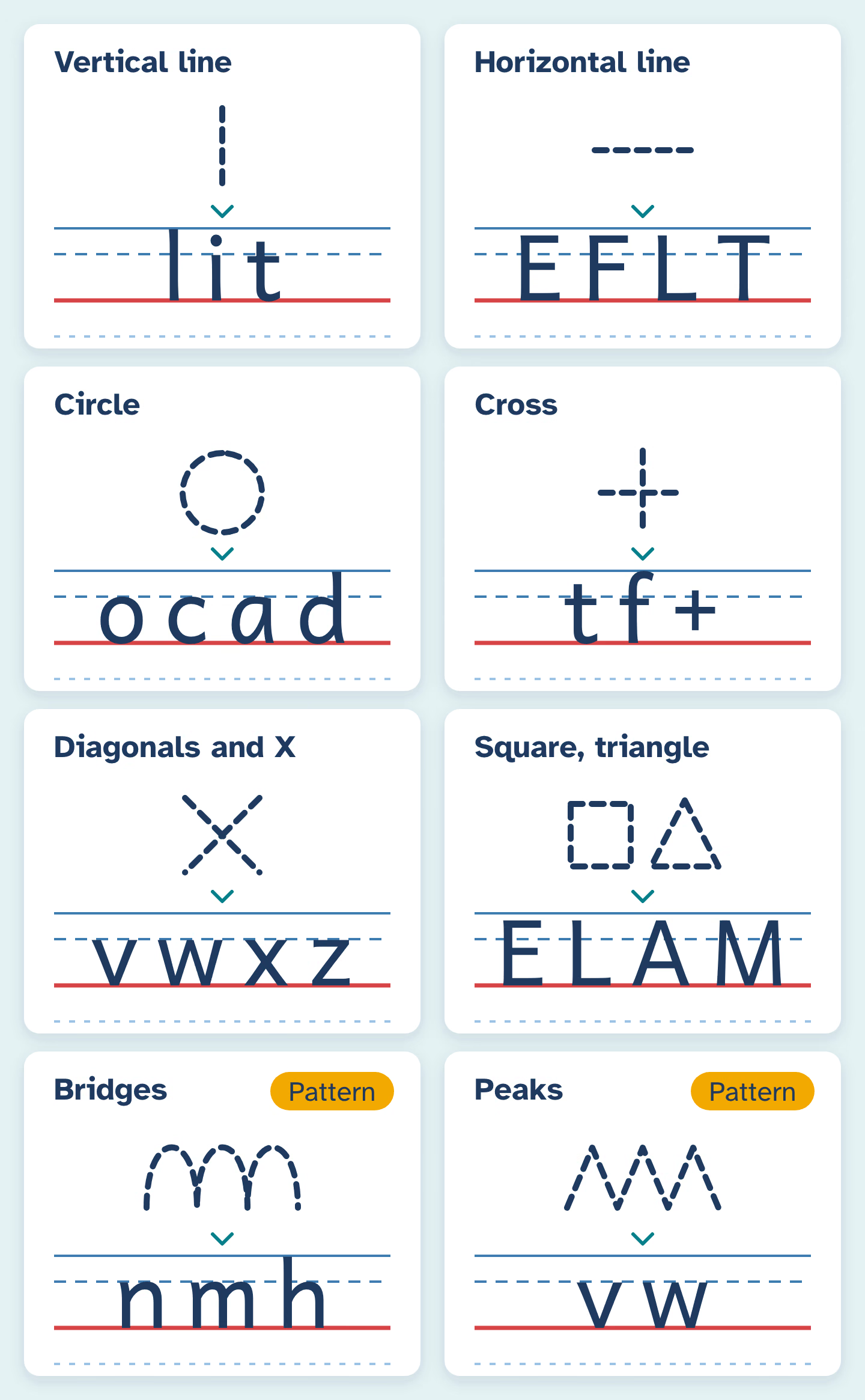
It helps to point out the link when the time comes. The Solihull handout gives the simplest example: a circle is the same as an o.
- Vertical line: l, i and t, and the tall sticks of b, d, h and k.
- Horizontal line: the bar on t, f and e, and capitals such as E, F, H, L and T.
- Circle: o, and the round part of a, d, g and q. A part-circle makes c.
- Cross: t, f and the plus sign.
- Diagonals and X: v, w, x, y, z and k, and capitals such as A, K, M, N, V and W.
- Square and triangle: the stop-and-turn corners of capitals such as E and L, and the pointed tops of A and M.
Patterns are the next step after pre-writing shapes. The NSW Department of Education’s guide for parents describes teachers moving from shapes such as straight lines and circles to patterns such as a soft wave or pointed peaks, before children write over letters with a starting dot. A row of soft waves or bridges is the over-and-down movement of n, m and h. Pointed peaks are the zigzag of v and w.
Imitating, copying and tracing
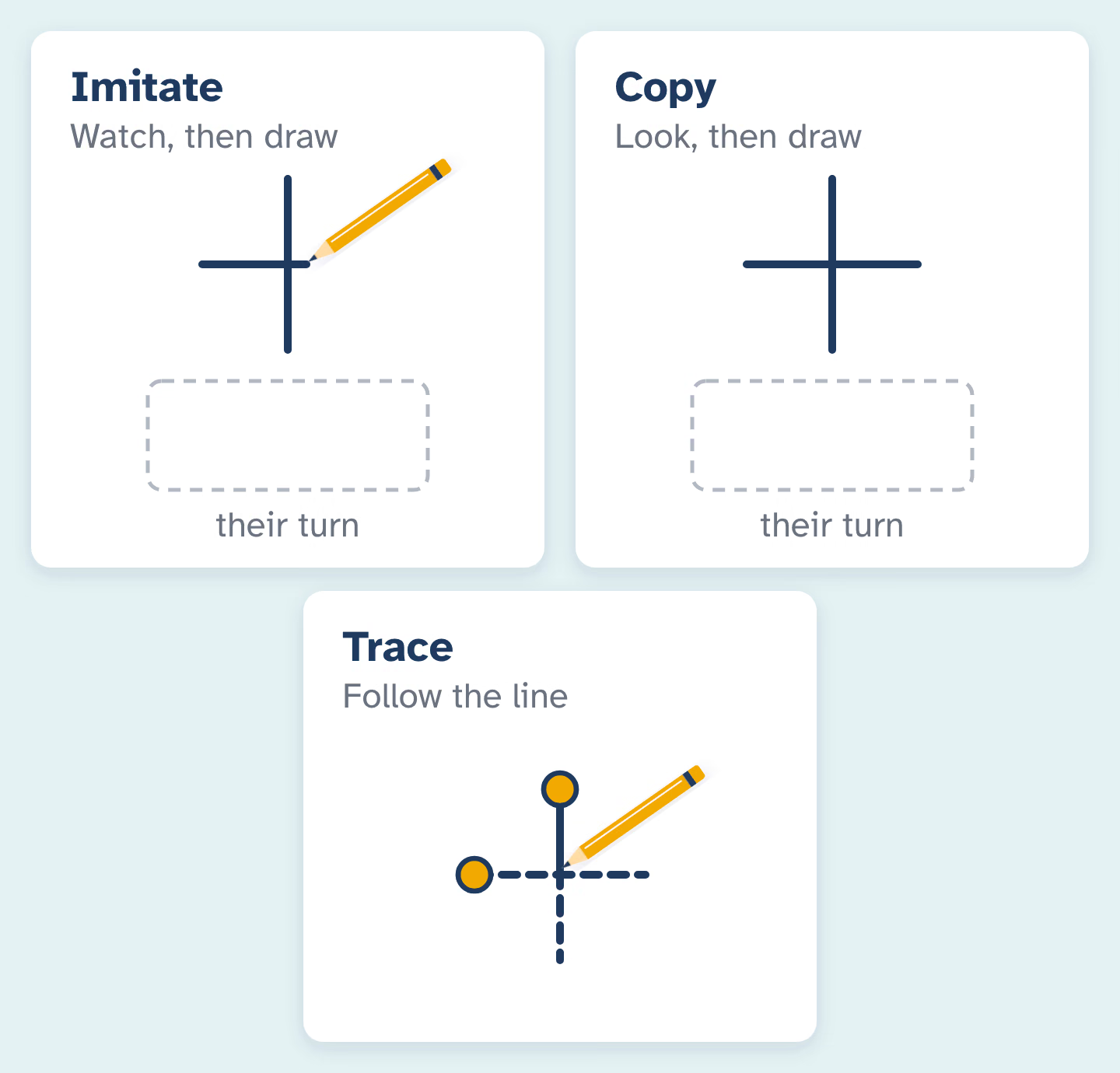
These are three different jobs, and it helps to know which one you are asking for.
- Imitating means watching you draw the shape, then drawing it. Your movement shows them where to start and which way to go.
- Copying means looking at a finished shape and working out how to draw it. This is harder, and it is what the age charts measure.
- Tracing means following a line that is already there. It builds control and teaches the path, but it doesn’t show whether a child can produce the shape alone.
The Royal Children’s Hospital sheet suggests a natural order: show your child how to draw the line or shape, ask them to do it, then see if they can draw it by themselves. It also suggests tracing shapes with a finger before a pencil, and tracing around cardboard stencils before trying the shape without one.
Keep the direction consistent from the start: lines go top to bottom and left to right, as NHS Fife describes, and circles start at the top. The Solihull service suggests using simple direction words while your child draws, such as “down”, “across” and “round”. Those are the same words they will hear later for letters. When your child is ready for pencil work, printable shape tracing sheets give them a clear path to follow. Ask for one of their own beside each traced row, so you can see what they can do without the guide.
Activities that build each shape
Start big and messy, then get smaller and neater. Large movements use the whole arm and shoulder, and Solihull notes they also help a child form a mental picture of the shape.
- Air drawing. Play “Simon says draw a circle”, or draw shapes in the air with a ribbon tied to a stick and have your child copy you.
- Finger drawing. Shaving foam on a mirror or bathroom tiles, or a tray of sand, for dots, lines, circles and squares.
- Racetracks. NHS Fife suggests two lines about 5 cm apart for a toy car or a finger to race along. Make the track narrower over time and add zigzags, bridges and junctions.
- Floor shapes. Mark large lines and shapes on the floor with masking tape or chalk for your child to walk along, then drive cars along them.
- Playdough worms. Roll long worms and bend them into lines, circles and crosses, an idea from the AOTA infographic.
- Back drawing. Draw a shape on your child’s back with a finger and let them guess it, then swap.
- Upright surfaces. The Royal Children’s Hospital recommends drawing on a blackboard, painting at an easel or sticking stickers onto paper taped to a wall, which works the arm and hand.
- Small tools. Short pencils, small pieces of chalk and crayons encourage finger control, according to the Solihull handout.
Keep it playful, and don’t rush letters
The Royal Children’s Hospital advice is direct: don’t be too eager to teach your child to write letters; have fun drawing together, copying shapes and colouring in instead. Solihull suggests keeping the focus on lines and shapes rather than letters during mark-making play, and stopping if your child doesn’t want to carry on.
Aim for what Solihull calls the “just right” challenge: hard enough to stretch your child, easy enough that they succeed. Praise the specific action (“your line went all the way down to the bottom”) rather than the drawing in general. Some children benefit from hands-on help, with your hand over or under theirs as they draw a shape. If your child hasn’t settled on a dominant hand yet, don’t choose one for them; put crayons down in the middle so they pick freely.
When a child finds pre-writing shapes hard
First, go back a step. Make it bigger, use a finger in sand before a pencil on paper, and let them imitate you before you ask them to copy. Check the foundations too: weak shoulders and hands make every shape harder, and our guide to fine motor activities has ideas for building them.
If your child is starting school and still can’t copy a circle or a cross after plenty of relaxed practice, or avoids drawing altogether, mention it to their teacher or your GP. An occupational therapist can look at what is getting in the way, whether that is strength, coordination, vision or something else.
Questions
Should my child trace shapes or copy them?
Both. Tracing teaches the path and builds control. Copying shows whether your child can make the shape alone, which is what matters for letters. A good routine is to trace a row, then draw one or two without the guide.
Which diagonal line should come first?
The charts disagree, so don’t worry about it. Teach both, starting at the top each time, and expect one to feel easier than the other for a while.
My child can write some letters but can’t draw a triangle. Is that a problem?
Usually not. The triangle is the last shape on the charts, at a little after five, so it is common for it to lag behind a few favourite letters. Keep drawing shapes alongside the letters.
Are zigzags, waves and loops pre-writing shapes too?
They are usually called pre-writing patterns. They come once single shapes are steady and build the rhythm of letters such as n, m, v and w, and later the joins in joined handwriting.
Sources
- Solihull Children’s Occupational Therapy Service, University Hospitals Birmingham NHS Foundation Trust: Pre-writing skills
- American Occupational Therapy Association, Children and Youth Special Interest Section: Pre-writing and handwriting skills infographic
- NHS Fife Children and Young People’s Occupational Therapy: Top tips for developing pre-writing skills
- Royal Children’s Hospital Melbourne, Occupational Therapy: Prewriting skills and activity ideas
- Aneurin Bevan University Health Board, Occupational Therapy Service for Children and Young People: Development of a tripod pencil grip
- NSW Department of Education, Handwriting in the early years


