


Yes, tracing worksheets help as one step in learning a letter, but not as the whole method. Studies with young children find that tracing and copying by hand both teach letters better than typing, and that children do best when they see how a letter is formed, trace it, then copy it and write it from memory. Tracing on its own, with nobody watching the pencil, can lock in the wrong movements.
Does tracing help? What the research shows
There isn’t a large body of research on tracing sheets themselves, but a few studies are worth knowing. None of them says tracing is useless, and none says it’s enough.
Tracing beats typing, and free copying does a little better still. In a 2025 study, Gorka Ibaibarriaga, Joana Acha and Manuel Perea worked with 50 five-year-olds who couldn’t yet read. The children learned nine unfamiliar letters, taken from the Georgian and Armenian alphabets, and short made-up words built from them. Children practised by copying by hand onto blank paper, tracing over dots, or typing. Both handwriting groups did better than both typing groups at naming, writing and recognising what they’d learned. The children who copied freely named the letters more accurately than those who traced, and scored higher on the other tasks too, although with only a dozen or so children per group, most of those gaps weren’t statistically clear.
Children’s own wobbly attempts seem to matter. Karin James and Laura Engelhardt had 15 children aged four to five print letters freehand, trace them or type them, then scanned their brains while they looked at the letters. Only the letters they had printed freehand switched on the brain network involved in reading. The authors suggest that the natural variation in a child’s own attempts helps them work out what makes an a an a. It was one short session with a small group, and it measured brain activity rather than reading, so treat it as a clue rather than proof.
Seeing the strokes and writing from memory works best
Steve Graham, summing up handwriting research for teachers, describes a study with first graders at risk of handwriting problems. Looking at a model letter marked with numbered arrows, which show the order and direction of each stroke, then writing the letter from memory, produced the best handwriting. The US Institute of Education Sciences practice guide on teaching writing recommends both: guided practice with numbered arrows, and writing letters with the model covered for gradually longer.
Why tracing worksheets alone fall short
A dotted letter shows the shape, not the path. A child can trace an a by starting at the bottom and going the wrong way round, and the finished letter still looks perfect. Nobody checking the sheet afterwards can tell.
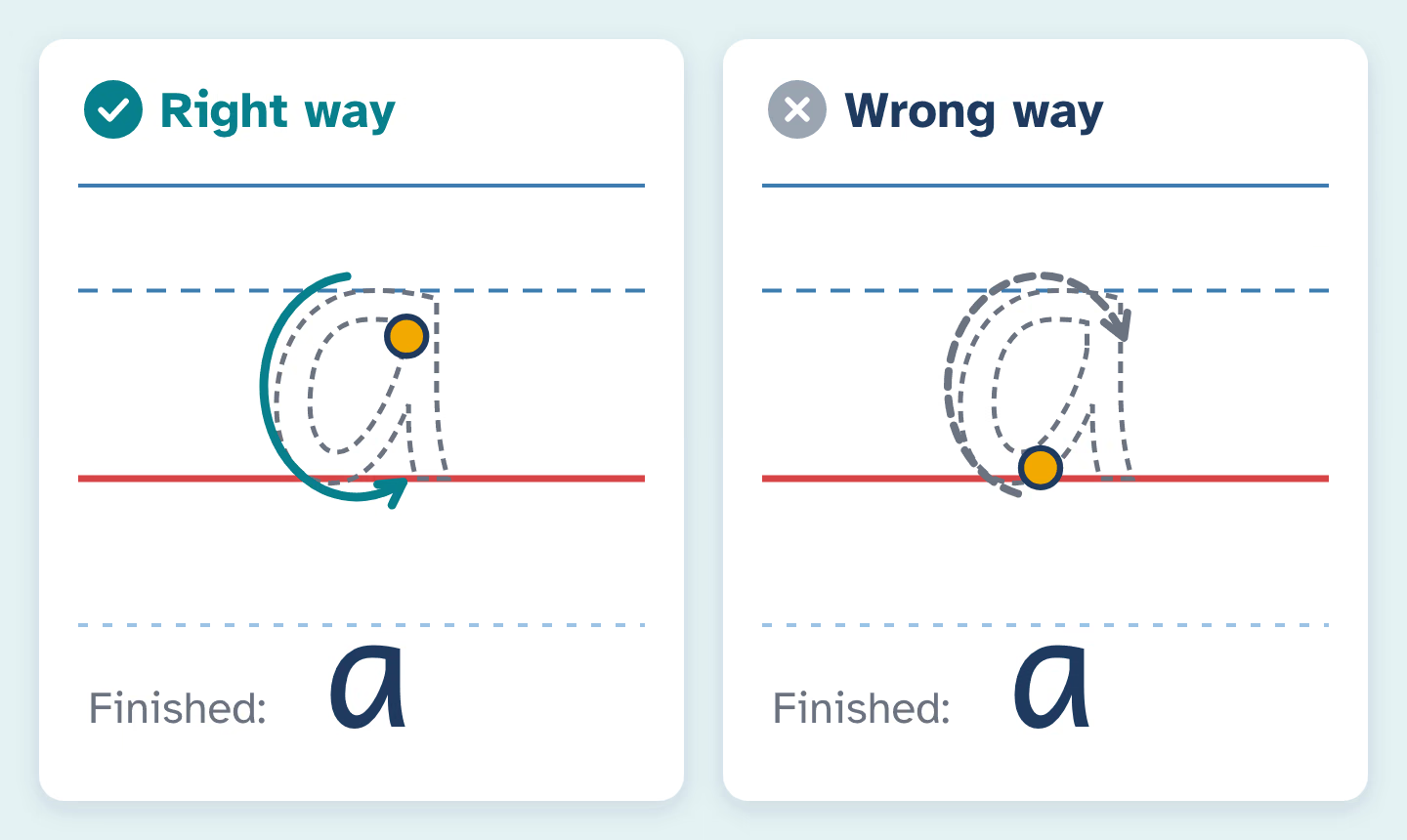
England’s writing framework for schools, published by the Department for Education in 2025, makes the point directly. It warns that asking children to copy from the board, trace around dotted letters or practise without supervision can stop them building a strong mental model of the movements behind each letter. Children may not notice how a letter is formed, and carry on forming it badly.
Tracing also makes decisions for the child. The dots set the size, the spacing and where the letter sits on the line. That’s how tracing worksheets help on day one. By week three your child needs to make those decisions alone, and dots can’t teach that. The IES guide also notes that young children tend to “draw” letters rather than write them, using more strokes than they need. Watching your child trace is a good way to spot it.
When tracing earns its place
Tracing worksheets help most at the start: a new letter, a new handwriting style such as the first weeks of joined writing, or a child who needs to feel a movement before they can produce it. Joana Acha, one of the Spanish researchers, made the same point in her university’s report on the study. Tracing helps children practise at first, she said, but once they can make fairly small, precise movements, it’s better to move on to free writing.
Graham’s handwriting program shows how tracing fits into a sequence. For each new letter, the teacher demonstrates the strokes and describes them aloud. Children trace a copy marked with numbered arrows, trace three copies without arrows, write the letter three times inside an outline, then write it three times on ordinary lines. Tracing is the first rung of the ladder, not the ladder.
How to use tracing worksheets well
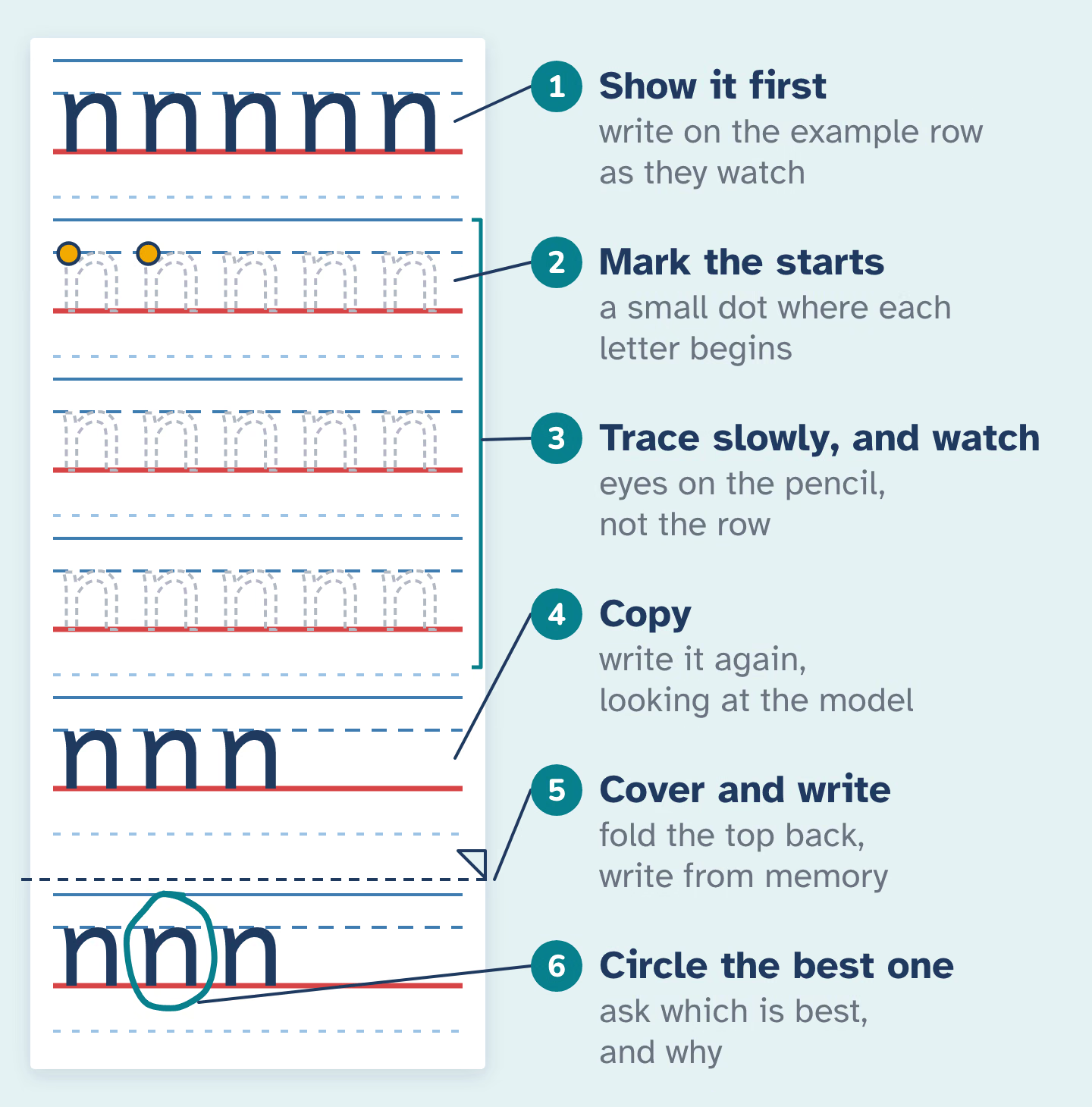
- Show it first. Write the letter on the example row while your child watches, saying the strokes: “Start at the top, go down, back up and over” for n.
- Mark the starts. If your child needs it, add a small coloured dot where each letter begins.
- Trace slowly, and watch. Keep your eyes on the pencil, not the finished row. If a letter starts in the wrong place, stop and show it again.
- Copy. On the blank rows, your child writes the letter again while looking at the model.
- Cover and write. Fold the model out of sight and write it from memory. Make the wait a little longer each time, as the IES guide suggests.
- Circle the best one. Ask your child which letter is best and why. Graham’s program includes the same step.
Keep it short. The IES guide suggests practising a letter perhaps five to eight times before moving to something else, in several short sessions rather than one long one, and says letters practised alone aren’t enough: children also need to use them in words and sentences. So a sheet works best for one letter, a small group of letters or a name, not the whole alphabet in one sitting.
Our free makers are laid out for this sequence. Each page has an example row, tracing rows and blank rows on four handwriting lines, and you can choose dotted-outline letters for the tracing rows. Use the letter tracing worksheet maker for single letters and the name tracing maker for names, in the handwriting style your school teaches.
What to watch while they trace
- The starting point. Check it on every letter. It’s the habit that matters most later, and the one tracing hides best.
- Direction. In the print styles schools teach, round letters such as c, a, d, g and o start near the top and go anticlockwise.
- Lifts in odd places. A child who lifts the pencil halfway round an o is drawing it in pieces. Show it again as one movement.
- Pace. Racing sends the line off the dots; creeping from dot to dot turns writing into drawing. Aim for a steady, smooth movement.
- Grip and pressure. White knuckles or torn paper mean the hand is working too hard. Our pencil grip guide explains what to look for.
When something goes wrong, don’t rub it out mid-letter. Say “Watch me do that one,” demonstrate, and let your child trace the next. Praise the process rather than the neatness: “You started at the top. That’s exactly right.” Our guide to teaching letter formation has the words for each letter.
When to move on from the dots
Your child is ready to trace less when they start most letters in the right place without a dot, go in the right direction while you watch, and can write the letter from memory, even if it’s a bit wobbly. From then on, use the tracing rows as a quick warm-up or skip them, and spend the time on the blank rows. Bring tracing back for genuinely new letters, or for the first week of a new style.
Sheets with gaps are a good bridge from tracing to writing alone. On a missing letter worksheet, for example, your child has to remember each missing letter and how it’s formed, rather than follow a dotted path.
Some children need the help of tracing worksheets for longer, and that’s fine. If your child still can’t form most letters from memory well into their first year of school (Kindergarten, Prep, Foundation, Reception or Year 1, depending on where you live), talk to the teacher.
Questions
Are tracing apps as good as paper?
For handwriting practice, paper and pencil are the better choice. England’s writing framework recommends them for handwriting lessons because children benefit from the friction they create. In the Spanish study, children who typed letters rather than forming them learned noticeably less.
My child traces neatly but can’t write the letter alone. Why?
Tracing lets the dots carry the shape, so the letter hasn’t been stored in memory yet. Shift the time to steps four and five above: copy, then cover and write, a few letters a day.
Should preschoolers use tracing sheets at all?
Yes. Tracing worksheets help in small doses, with an adult beside them, and after plenty of hands-on practice such as building and painting letters. Our name writing activities and pre-writing shapes guides suggest what to do first.
How much tracing is too much?
If most of your child’s writing time is tracing, it’s too much. A few traced letters to warm up, then most of the time on copying and writing from memory, is a better balance.
Sources
- Ibaibarriaga, Acha and Perea, “The impact of handwriting and typing practice in children’s letter and word learning: Implications for literacy development”, Journal of Experimental Child Psychology (2025)
- University of the Basque Country (UPV/EHU), Children’s reading and writing develop better when they are trained in handwriting (2025)
- James and Engelhardt, “The effects of handwriting experience on functional brain development in pre-literate children”, Trends in Neuroscience and Education (2012)
- Steve Graham, “Want to improve children’s writing? Don’t neglect their handwriting”, American Educator (2009/10)
- Institute of Education Sciences, What Works Clearinghouse, Teaching elementary school students to be effective writers (practice guide, 2012)
- Department for Education (England), The writing framework (2025)


