


Pencil grip develops in stages, from a whole-fist grip in toddlers, through all four fingers on the pencil, to a three-finger “tripod” grip. Many children start using a tripod grip at around four or five, and most have settled into a mature grip by six or seven. A grip that isn’t textbook is fine if your child writes comfortably and legibly at a reasonable pace. It is worth working on when it causes pain, tiredness or very slow writing.
The stages of pencil grip
The children’s occupational therapy service at Aneurin Bevan University Health Board in Wales describes five stages. You will see the names in OT reports, so they are worth knowing.
- Fisted grip (palmar supinate). The crayon is held like a dagger and the whole arm does the scribbling.
- Digital pronate grip. All the fingers hold the crayon, but the palm faces down towards the page and movement comes mostly from the elbow.
- Four-finger grip (quadrupod). Four fingertips are on the pencil and the wrist starts to do the moving, with hand and fingers working as one unit.
- Static tripod. Thumb, index and middle finger hold the pencil, but they still move together as a block.
- Dynamic tripod. The fingertips move the pencil while the hand, wrist and arm stay steady. The ring and little fingers curl gently into the palm, the gap between thumb and index finger opens into a rounded shape, and the pencil is held close to the point.
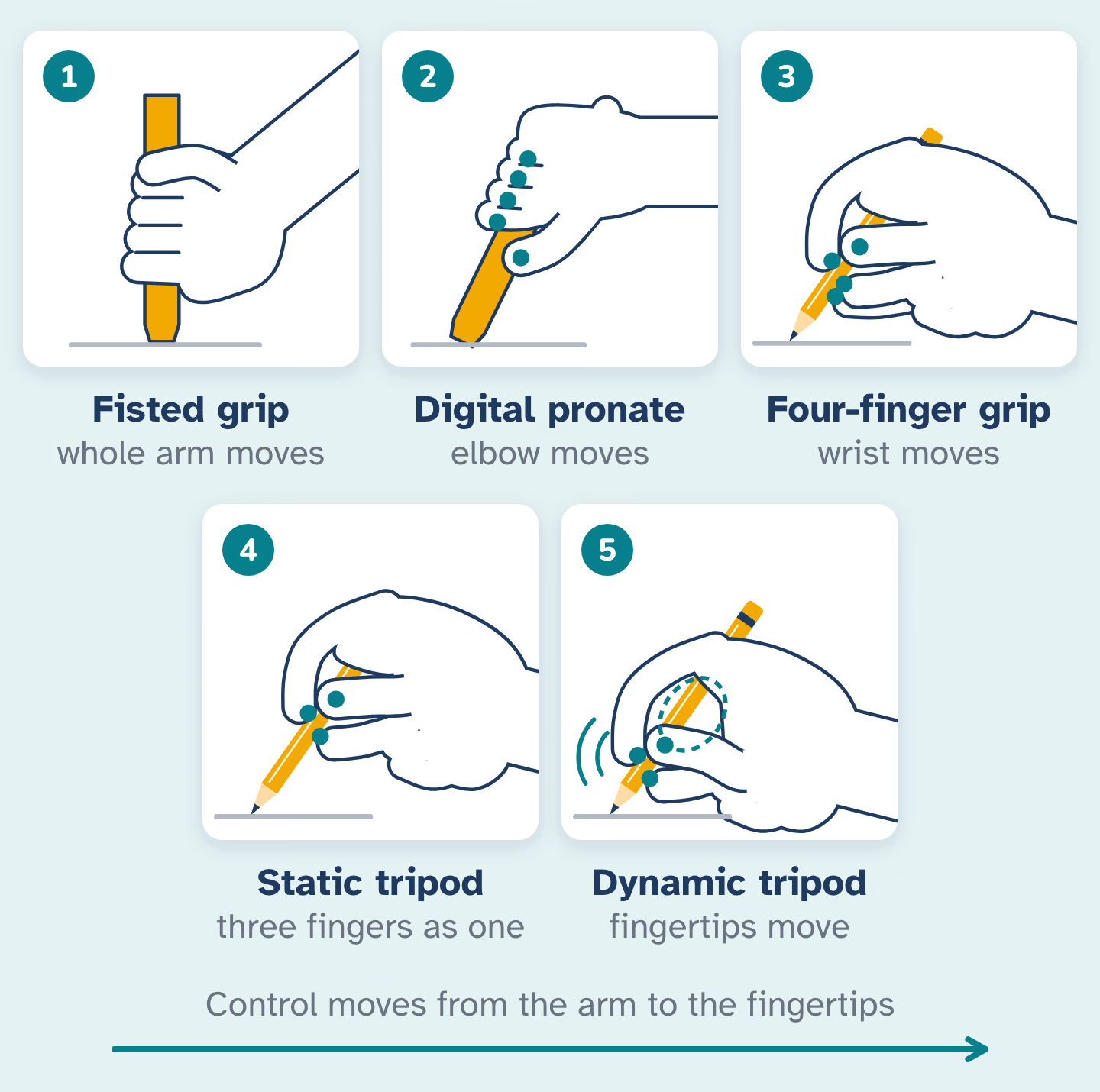
Underneath the stages is a simple pattern. The same service explains that larger muscles close to the body develop before the small muscles of the hand. As a result, control moves from the whole arm, to the wrist, and finally to the fingertips. A child whose shoulders and hands are still weak will hold the pencil in an earlier way, whatever you tell them.
What’s normal at each age
Sources give slightly different ages, so read these as rough ranges rather than deadlines.
- First crayons: toddlers grab with the whole hand and scribble from the shoulder.
- By four: the CDC lists “holds crayon or pencil between fingers and thumb (not a fist)” as a milestone. CDC milestones are things at least three in four children can do by that age.
- Four to five: the paediatric OT team at Central Coast Local Health District in NSW says children should start to use the tripod grasp at about this age.
- End of the first year of school: in England, the expected level at the end of Reception includes holding a pencil effectively, “using the tripod grip in almost all cases”.
- Six to seven: the Aneurin Bevan service says most children master the tripod grip by this age, so there is no need to worry if a child isn’t holding the pencil properly when they start school.
Expect a mix along the way. A five-year-old may use a tripod for a careful drawing and slip back to a fist for fast colouring. England’s early years guidance describes exactly this in a child who is still emerging: occasional attempts at a tripod hold, then a return to a less efficient grip after being shown.
Grips that work even if they aren’t textbook
The dynamic tripod is the grip most schools teach, and it is a good default. But it isn’t the only grip that works. Canadian researchers studied 120 Grade 4 children and compared four mature grips: the dynamic tripod, the lateral tripod (where the thumb crosses over and presses the pencil against the side of the index finger), and four-finger versions of each. They tested handwriting before and after a 10-minute copying task designed to tire the hand. The grips made no difference to speed or legibility, before or after, and the authors questioned the usual practice of teaching the dynamic tripod to everyone.
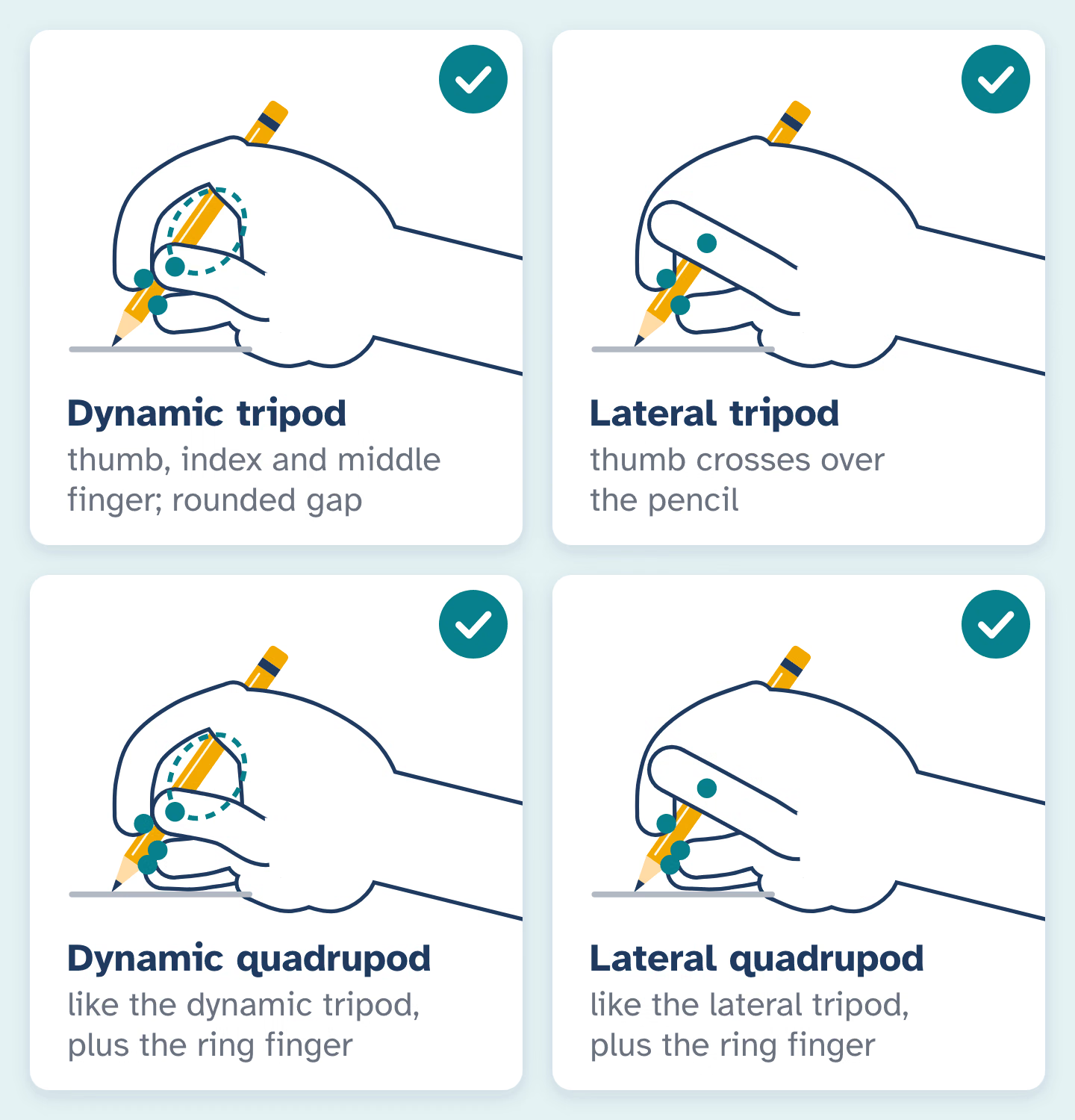
Ireland’s Health Service Executive takes the same practical view. Its handwriting guidance describes the tripod, the four-finger quadrupod and an adapted tripod that suits the individual child, and says the most important thing is that the child can write as easily as possible and their writing is legible. A child who is comfortable, doesn’t tire quickly, keeps up and writes clearly may not need a change at all.
Signs a pencil grip needs attention
Look at what the grip does, not how it looks. It is worth working on if:
- your child complains that their hand hurts, or shakes it out after a few lines
- writing is much slower or messier than their classmates’
- they press so hard the pencil tears the paper or the lead keeps snapping
- a fist grip is still the usual grip well into the first year of school
- they avoid drawing and writing whenever they can
How to help a preschooler: strength first
With young children, resist the urge to position their fingers every time they pick up a crayon. The Central Coast OT team warns against forcing a grip that is too hard for a child’s age and skill: asking for a tripod before the muscles are strong enough can lead to habits that are hard to correct later. Build the strength instead. The Aneurin Bevan service suggests:
- lying on the tummy, propped on the forearms, to draw, read or play
- push and pull games and hanging from monkey bars, for shoulder strength
- painting at an easel and using a rolling pin, for steady wrists
- trigger spray bottles and hole punches, for grip strength
- finger puppets and finger rhymes such as Incy Wincy Spider, for moving fingers separately
- threading small beads, using pegs and pinching playdough, for the pinch a tripod grip relies on
Give young children chunky crayons or thick pencils, which the Central Coast team says are easier to grasp. The HSE adds that some children grip better with a shorter or triangular pencil, and that easels, whiteboards and slanted surfaces can make drawing feel more natural. There are many more ideas in our guide to fine motor activities.
How to teach the grip itself
Once your child is around four or five and has the strength, you can teach the tripod directly. These ideas come from the Central Coast and HSE guidance:
- Help from behind. Sit next to or behind your child, put your hand over theirs and guide their fingers into place. Older children may only need their fingers moved to the right spot.
- Mark the spot. A sticker near the bottom of the pencil shows where the fingers go.
- Tuck the spare fingers. A pea-sized piece of Blu Tack or similar putty, a cotton ball or a bit of sponge held by the ring and little fingers keeps them out of the way, leaving thumb, pointer and middle finger to hold the pencil.
- Use one short reminder. The Central Coast team suggests “Hold your pencil at the bottom using your three fingers.” Say it the same way every time.
- Try a pencil grip. The HSE notes that grips from stationery shops can show children where to hold the pencil.
Then give the new grip something worth doing. Big, simple strokes are easier to control than letters, so printable shape tracing sheets make good first practice. For a child who is keen to write, their own name is the most motivating word there is, and the name tracing maker prints it in your school’s style.
Posture and paper position
Grip is easier when the body is steady. The HSE suggests feet flat on the floor or a footrest, hips and knees at roughly right angles, and a table a little below elbow height. It doesn’t need to be rigid; comfort and support matter more than exact angles.
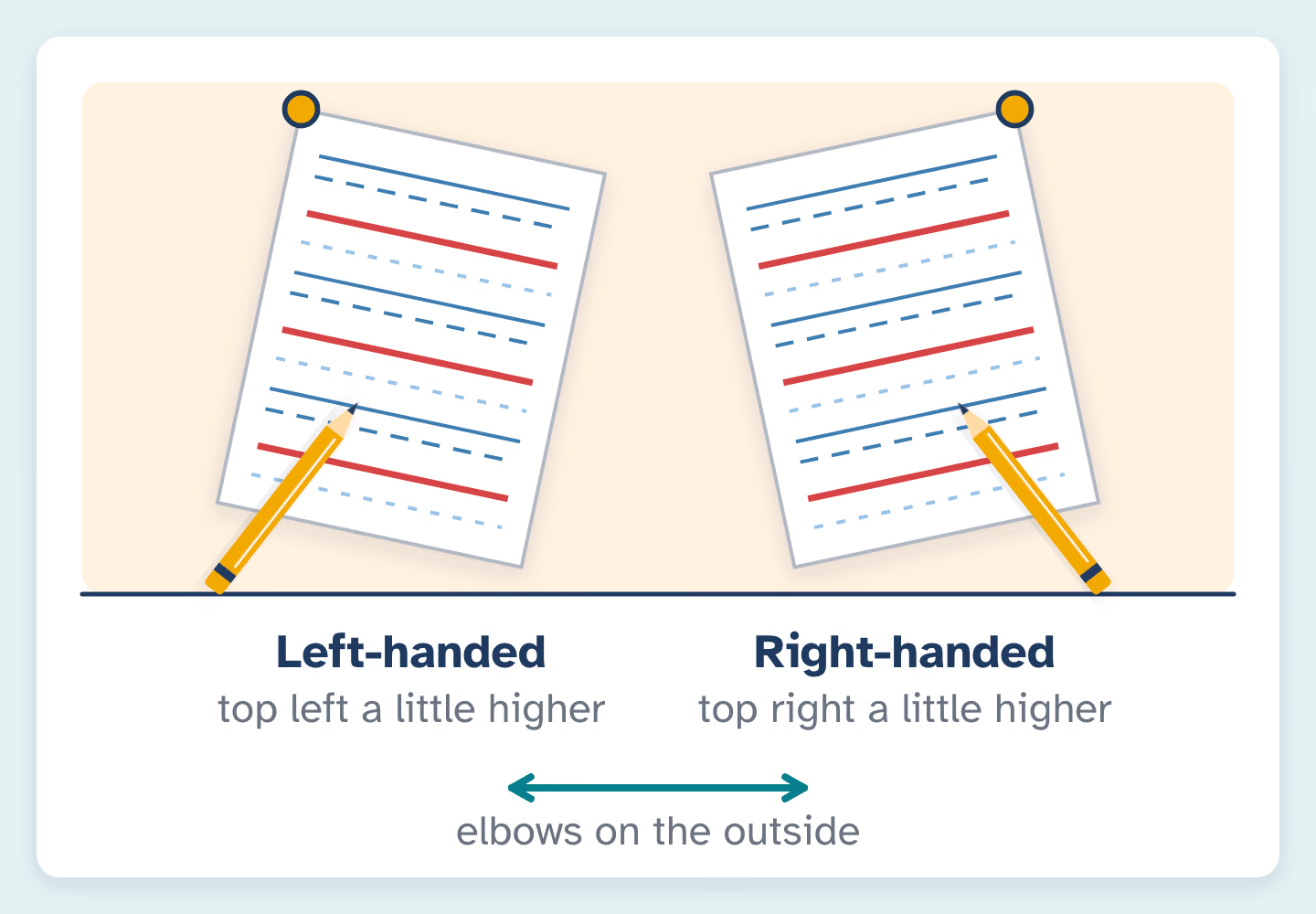
Tilt the paper slightly. For left-handed children the HSE suggests raising the top left corner a little higher than the right, with right-handers tilting the opposite way, and seating a left-hander on the left of a right-handed neighbour so their elbows don’t clash. Our guide for left-handed writers goes further.
When to get advice
Talk to the class teacher if your child has pain when writing, tires quickly, falls well behind in written work, or still uses a fist grip most of the time after starting school. The school, your GP or your paediatrician can refer you to an occupational therapist, who can look at strength, posture and coordination as well as the grip itself. The HSE points out that hand-strengthening activities do not always lead to a better pencil grasp on their own. That is why an OT’s targeted help can make the difference.
Questions about pencil grip
My five-year-old uses four fingers. Should I change it?
Not if it is comfortable and working. A four-finger grip is a mature grip, and in the Grade 4 study it was just as fast and legible as the tripod. Keep an eye on comfort as writing tasks get longer.
Do pencil grips work?
They can help a child find the right finger positions, and some children like them. They are a prompt, not a cure. If a grip makes writing harder or your child keeps taking it off, stop using it and try a shorter or triangular pencil instead.
Is it too late to change a seven-year-old’s grip?
Established grips are hard to change, and research suggests several grips work well. Only try if the current grip causes pain, fatigue or writing that can’t keep up, and ideally with an occupational therapist’s advice.
Should I stop my toddler holding crayons in a fist?
No. A fist grip is the normal starting point. Offer chunky crayons, plenty of scribbling time and lots of play that builds the arms and hands, and the grip will move on as the muscles develop.
Sources
- Aneurin Bevan University Health Board, Occupational Therapy Service for Children and Young People: Development of a tripod pencil grip
- Central Coast Local Health District, Paediatric Occupational Therapy: Pencil grasp skills for children
- Health Service Executive (Ireland), Handwriting: posture, paper and pencil grasp
- Schwellnus et al., “Effect of pencil grasp on the speed and legibility of handwriting after a 10-minute copy task in Grade 4 children”, Australian Occupational Therapy Journal (2012)
- Centers for Disease Control and Prevention, Milestones by 4 years
- Department for Education (England), ELG: Gross and fine motor skills


