


It depends on where your child goes to school, because handwriting styles vary by country and, in Australia, by state. Most US schools start with upright print or a slanted, D’Nealian-style print, and many add cursive later. Each Australian state has its own named style, such as NSW Foundation Style, Queensland’s Beginner’s Alphabet or Victorian Modern Cursive. New Zealand teaches one basic script nationally, and schools in England choose their own style within the national curriculum. The fastest way to be sure is to look at the alphabet strip in your child’s classroom or ask the teacher which handwriting program the school follows.
Why home and school handwriting styles should match
Children are flexible readers. A five-year-old who learns a sloped Queensland a at school will still read the round a in a picture book without any trouble. Copying is different. Queensland’s handwriting handbook makes exactly this point: when children read an activity, the style hardly matters. But when they copy letters from a model, the model should be in the style they are learning to write.
The reason is movement. Children learn handwriting as a sequence of strokes: where the pencil starts, which way it travels, where it lifts. New Zealand’s Ministry of Education guidance tells teachers to focus on how the pencil moves rather than on copying a perfect model shape. If home practice uses a different starting point or a different k from the one taught at school, your child has two movements competing for the same letter. Matching the style keeps the practice pulling in one direction.
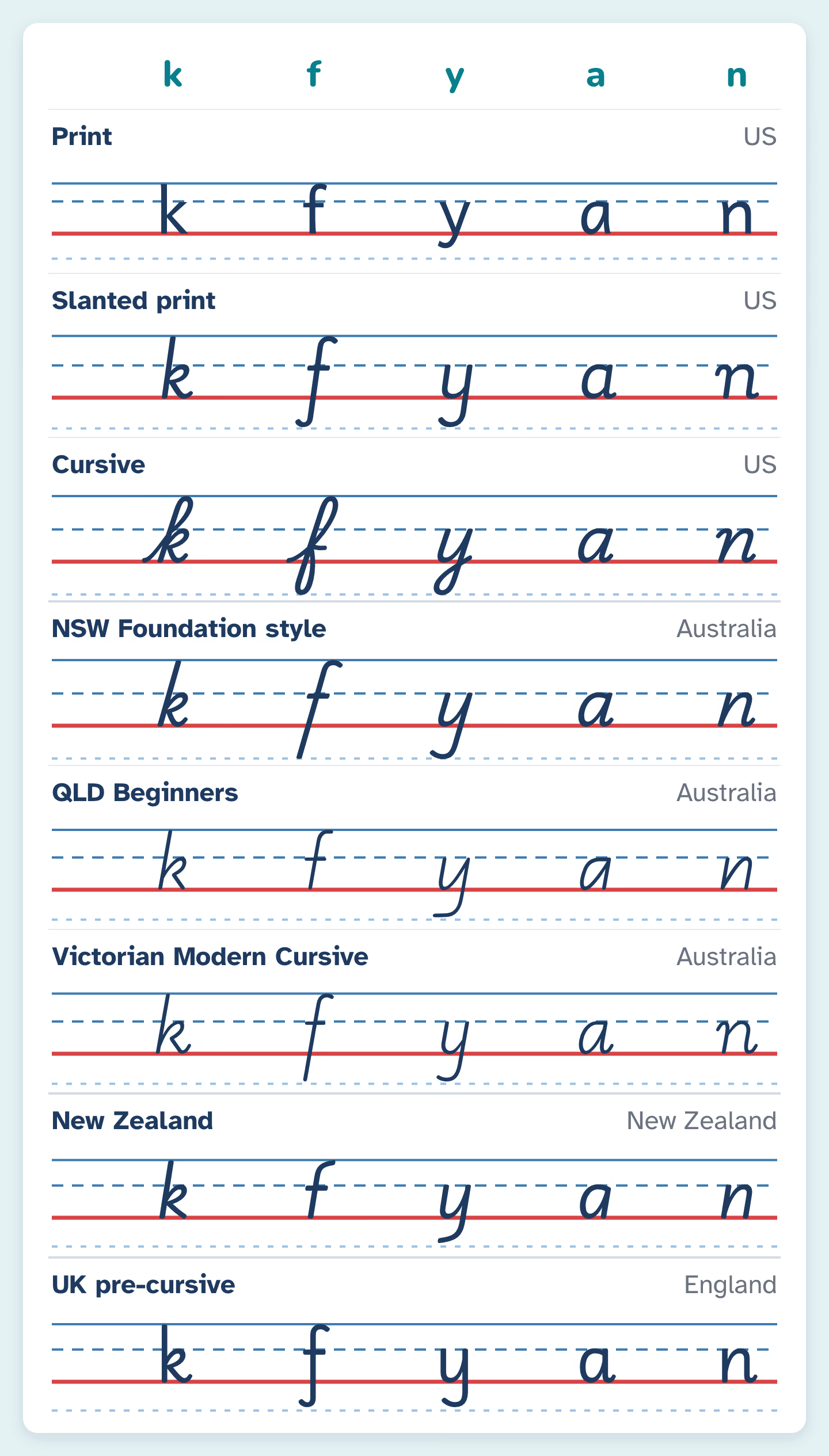
The differences between handwriting styles are often small but noticeable to a child: whether letters slope, whether they finish with a little flick, whether y has a straight tail or looks like a u with a tail, and whether k has a loop.
Australia: handwriting styles differ by state
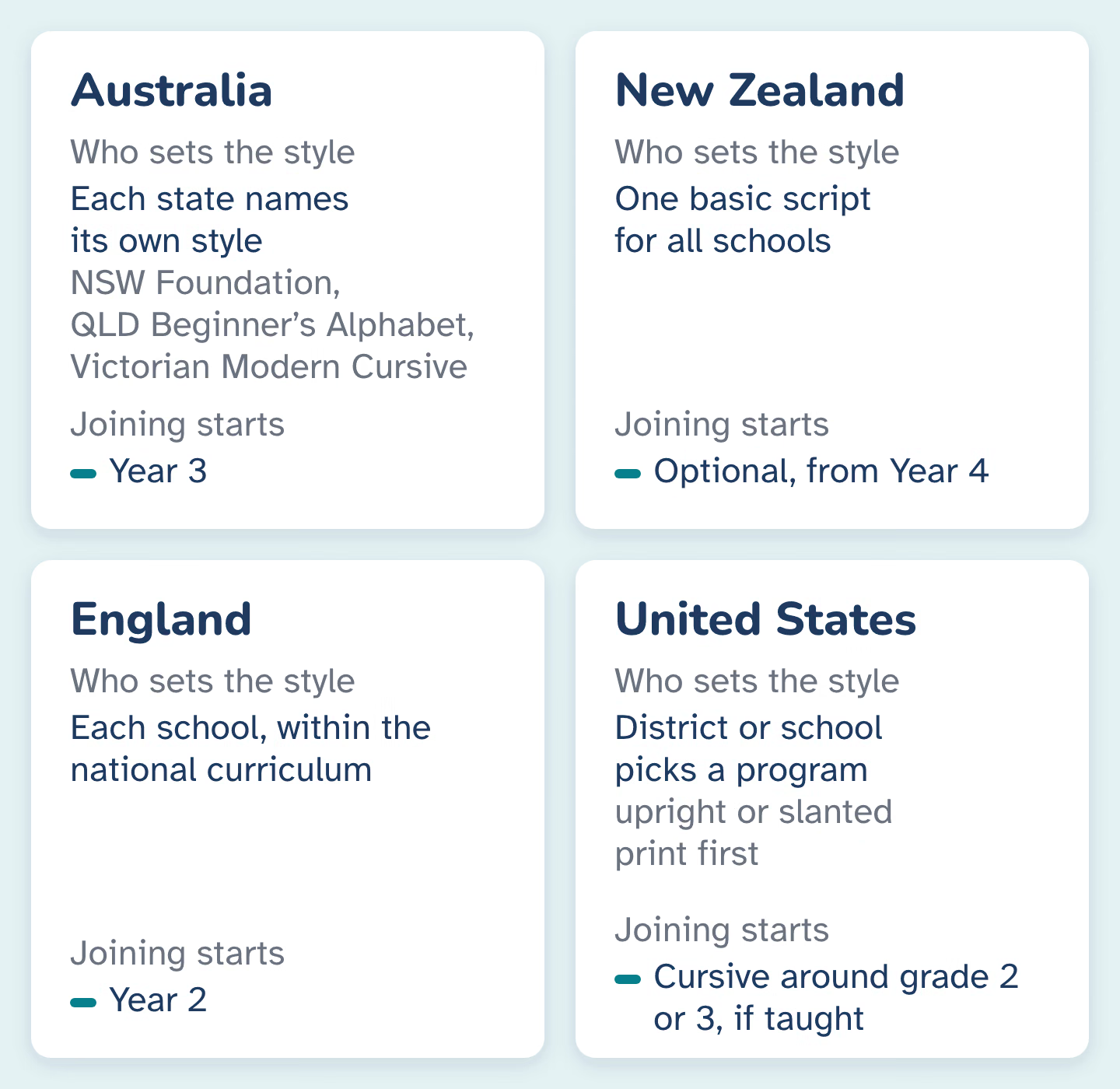
The Australian Curriculum sets out what children should be able to do, not which letter shapes to use. In Version 9.0, Foundation children form most lowercase and capital letters using the formations they’ve been taught, Years 1 and 2 write words with unjoined letters, and Year 3 moves to joined letters that are clearly formed and consistent in size. The style itself is set by each state.
New South Wales
NSW names its style in the syllabus itself. In Kindergarten, NESA’s English K–10 Syllabus expects children to form all letters in NSW Foundation Style from the correct starting point, following a verbal prompt. Years 1 and 2 form them from memory with consistent size and slope, and joining belongs to Stage 2 (Years 3 and 4). Our guide to NSW Foundation Style goes through each stage.
Queensland
Queensland children start with the Beginner’s Alphabet, a sloped print designed so that adding small entry and exit strokes later turns it into Queensland Modern Cursive. You’ll find the details in the Queensland Beginner’s Alphabet explained.
Victoria
Victorian schools use Victorian Modern Cursive. Children form separate letters from Foundation to Level 2 and join from Level 3, but the Foundation letters are already shaped with joining in mind. See how Victorian Modern Cursive is taught from Foundation.
Handwriting styles in other states and territories
South Australia and Tasmania have their own modern cursive styles, and schools elsewhere often use one of the larger states’ styles. If you live outside the three states above, ask the school rather than guessing from the postcode.
New Zealand: one basic script
New Zealand is simpler. The Ministry of Education’s Teaching Handwriting guidance, first published in 1985 and updated in 2025 for the new English learning area, says all learners from Years 0 to 8 should learn the same basic script. Lowercase letters come first, block capitals follow, and joining is optional: teachers may introduce linking letters from Year 4 for children who already write with ease. Read more in how New Zealand schools teach handwriting.
England: the school chooses, the curriculum sets the steps
The national curriculum in England doesn’t prescribe a font or a named style. It sets out stages instead. In Year 1, children learn to sit correctly, hold a pencil comfortably, form lowercase letters in the correct direction (starting and finishing in the right place), form capitals and digits, and practise letters in handwriting families. In Year 2 they start using some of the diagonal and horizontal strokes needed to join letters. By Years 3 and 4 they should use joined handwriting throughout their independent writing.
Within that framework, many schools teach a pre-cursive style, where separate letters finish with small exit flicks ready for joining. Others start with plain print. Scotland, Wales and Northern Ireland have their own curricula, so check locally there too.
United States: print first, cursive later
The Common Core standards used in many states expect kindergartners to “print many upper- and lowercase letters”, but they don’t name a style. Districts and schools pick a handwriting program, and most fall into one of two camps for print: upright letters built from straight lines and circles (often called ball-and-stick) or slanted letters with small tails, in the D’Nealian style. Cursive isn’t part of those standards, though some states have added their own cursive requirements. Schools that teach it usually start around second or third grade. Our guide to ball-and-stick, D’Nealian and cursive shows how to tell them apart.
How to work out which style your school uses
You rarely need to guess. Try these in order:
- Look at the alphabet strip. Many early-years classrooms display the school’s letters above the board or on desk name cards.
- Check the handwriting book. Workbook covers usually name the state or style, such as “NSW”, “QLD”, “VIC Modern Cursive” or a US program name.
- Compare a few tell-tale letters. Look at k, f and y, check whether the letters slope, and see whether letters like a and n finish with a flick.
- Ask the teacher. A quick note works well, and it’s worth asking when joining starts at the same time, because schools set their own timing within the curriculum.
If your child has switched schools and handwriting styles
Families move between states and countries all the time, and children arrive with letters learned somewhere else. Both the Queensland handbook and the New Zealand guidance take a relaxed line here. Queensland’s advice is not to pressure a newly enrolled child to change a style that is neat and legible, and to make changes only where the child is having problems. New Zealand’s guidance expects individual differences and asks teachers to accept them, as long as the basic form of the letter isn’t distorted.
In practice, that means you don’t need to start again. Focus on the letters that cause trouble: a letter started from the bottom, an o drawn clockwise, a b and d that keep swapping. Fix the movement first and let the small stylistic differences settle over time.
Practising at home in the right style
Short, frequent practice beats long sessions. Five to ten minutes, a few times a week, is usually enough in the first years of school. Say the movement out loud as your child writes (“start at the top, go down, back up and over” for n) and watch the letter being formed, not just the finished result.
If you’d like printed practice, NeatPencil’s free name tracing worksheets come in eight handwriting styles: US upright print, US slanted print, US cursive, NSW Foundation, Queensland Beginners, Victorian Modern Cursive, New Zealand basic and UK pre-cursive. Each page has an example row, tracing rows and blank rows on four handwriting lines, and there’s no sign-up. The fonts are openly licensed fonts modelled on each school style, so hold a page up against your school’s chart before you print a class set.
Questions about handwriting styles
Does it matter if my child uses a slightly different style at home?
For reading, no. For writing practice, try to match the school, especially starting points and stroke direction. Small differences in shape matter much less than the movement.
Which handwriting style is easiest to learn?
There’s no agreed answer, and every style has its supporters and critics. The official guidance puts its weight on explicit teaching, a consistent model and regular practice, whichever style a school uses.
When do children start joining letters?
It varies by country: Year 2 in England, Year 3 under the Australian Curriculum (Stage 2 in NSW), optional from Year 4 in New Zealand, and usually second or third grade in US schools that teach cursive. Our guide on when to teach joined handwriting covers the signs a child is ready.
What if my school uses a style that isn’t listed here?
Ask the teacher for a copy of the school’s alphabet chart and pick the closest style for home practice. Starting points and stroke direction are what to match first.
Sources
- NESA: English K–10 Syllabus (2022), Early Stage 1 content
- ACARA: Australian Curriculum Version 9.0, English scope and sequence F–10
- Department of Education, Queensland: The Teaching of Handwriting, a handbook (1984)
- Ministry of Education, New Zealand: Teaching Handwriting (Tāhūrangi)
- Department for Education: National curriculum in England, English programmes of study
- Common Core State Standards: English Language Arts, Language, Kindergarten


