


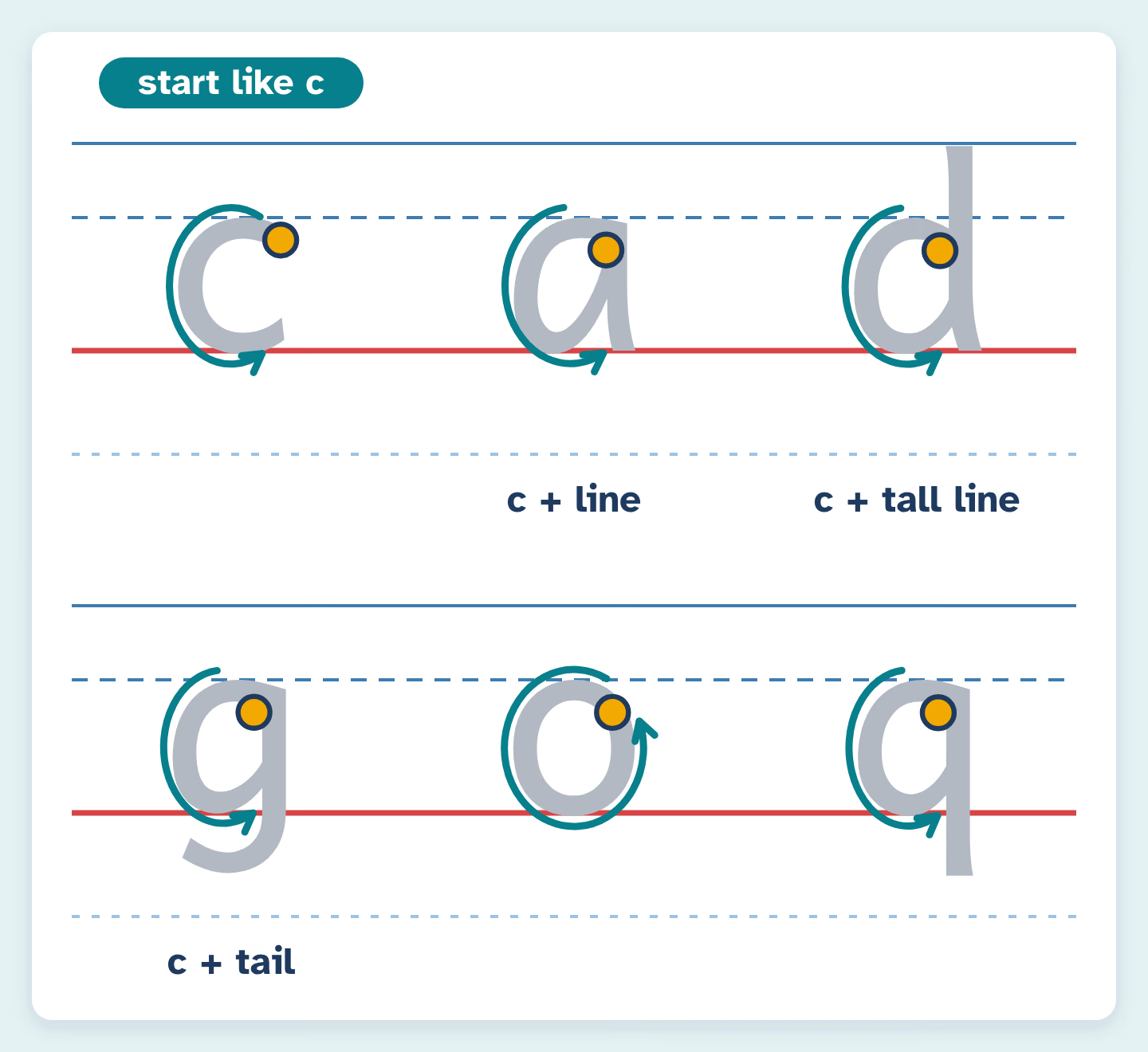
Teaching letters in families means grouping lowercase letters by the movement that forms them and teaching each group together, instead of working from a to z. The curly letters c, a, d, g, o and q, for example, all begin with the same stroke back around. Your child practises one movement many times, and every new letter builds on one they already know.
Why grouping letters in families works
Handwriting is a movement skill, and movements are learned by repetition. Occupational therapists at Aneurin Bevan University Health Board explain that repeating and comparing similar strokes helps a child learn both the shape and the feel of a letter. Once the curve of c is automatic, a is just c with a line, and d is c with a taller line.
Curriculum writers agree. England’s National Curriculum requires Year 1 pupils to learn which letters belong to which handwriting family and to practise them. NSW’s Kindergarten syllabus asks children to produce the base movements behind the letters: a clockwise ellipse, an anticlockwise ellipse and a downward diagonal stroke.
This is also why handwriting order and phonics order differ. England’s 2025 writing framework explains that phonics programs teach letters in the order that builds the most words for reading, while handwriting programs group letters with similar formation. Children need both, taught consistently. At home, you can help with whichever letters phonics brings up while keeping handwriting practice in families.
The usual letter families
Programmes group letters slightly differently, and schools give the families friendly names, so use whatever words your child hears at school. This grouping, adapted from the Aneurin Bevan therapy team’s advice, sorts letters by their main movement.
Straight-down letters: l, i, t, j, u, y
These start with a line down. Say “start at the top, straight down” for l, and “down, round, up and down” for u. The y is a u whose last stroke dives into a tail.
Curly letters: c, a, d, g, o, q
All start just below the midline and travel back around, anticlockwise. Say “back round like a c” every time. Then a is “round, up, down”, d is “round, up to the top line, down”, and g is “round, up, down into the tail.” The letter e is often taught with this family: it travels the same way but starts in the middle, with a short line across.
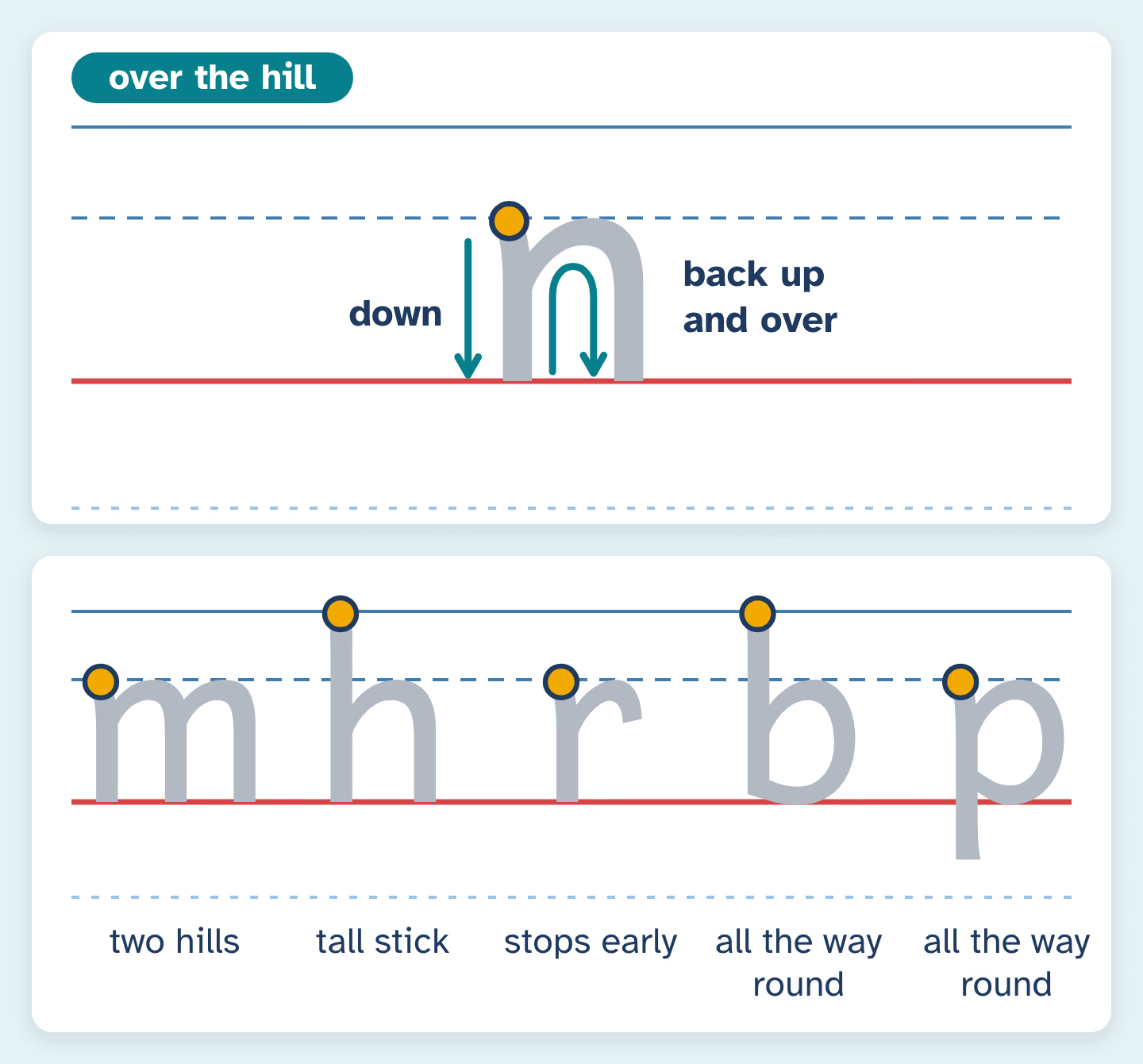
Over-the-hill letters: r, n, m, h, b, p
These go down, retrace back up the same line and arch over clockwise. Say “down, back up and over the hill” for n. The m has two hills, h is an n with a tall stick, r stops after the start of the hill, and b and p go all the way round.
Zigzag letters: v, w, x, z, k
These use slanting lines. Say “slide down, slide up” for v, and do it twice for w. The k sits here or with the straight-down letters, depending on the program.
A few letters, such as e, s, f and j, don’t fit neatly anywhere, and different programs place them differently. England’s writing framework, for instance, groups letters by where they start and lists these as typical families: c o a g q d; i l t k j; v w u y f; r n m h p b; and e s x z.
Which family to teach first
There are two sensible starting points. Straight-down letters are the easiest to make, which is why the first-grade handwriting program designed by researcher Steve Graham and colleagues begins with l, i and t. Curly letters are a strong second, because one movement covers six common letters. After that come the over-the-hill letters, then the zigzags and odd ones out.
Graham’s program grouped letters using four rules worth borrowing: letters in a group are formed in similar ways, common letters come before rare ones, easier letters come before harder ones, and easily confused pairs such as b and d or u and n are never taught in the same group.
A week with one family
- Make the movement big. Draw the shared stroke in the air, in sand, in shaving foam or with a paintbrush on the fence. Both the therapy team and England’s writing framework suggest starting large.
- Show and talk. Write the letters side by side and ask what is the same and what is different. In Graham’s program, teachers and children discuss exactly this.
- Trace, then copy, then write. Trace a letter with arrows, trace it without, then write it on lines. Our letter tracing worksheets come in each school style we support, with an example row to copy first. Sit with your child: the writing framework warns that unsupervised tracing lets wrong movements slip through.
- Close their eyes. The Aneurin Bevan therapists suggest practising letters with and then without vision. A child who can write the letter with eyes shut has learned the movement, not just the picture.
- Put the family into words. Once the letters are consistent, use short words your child can spell. With the curly family plus t, that might be dog, dad, cat and got. Word tracing worksheets work well here.
- Pick the best one. As in Graham’s program, ask your child to circle their best letter on each row. It keeps attention on quality rather than quantity.
A few minutes a day beats one long session. The writing framework also stresses consolidating each step before moving on, so children don’t practise mistakes.
How families help with the letters b and d
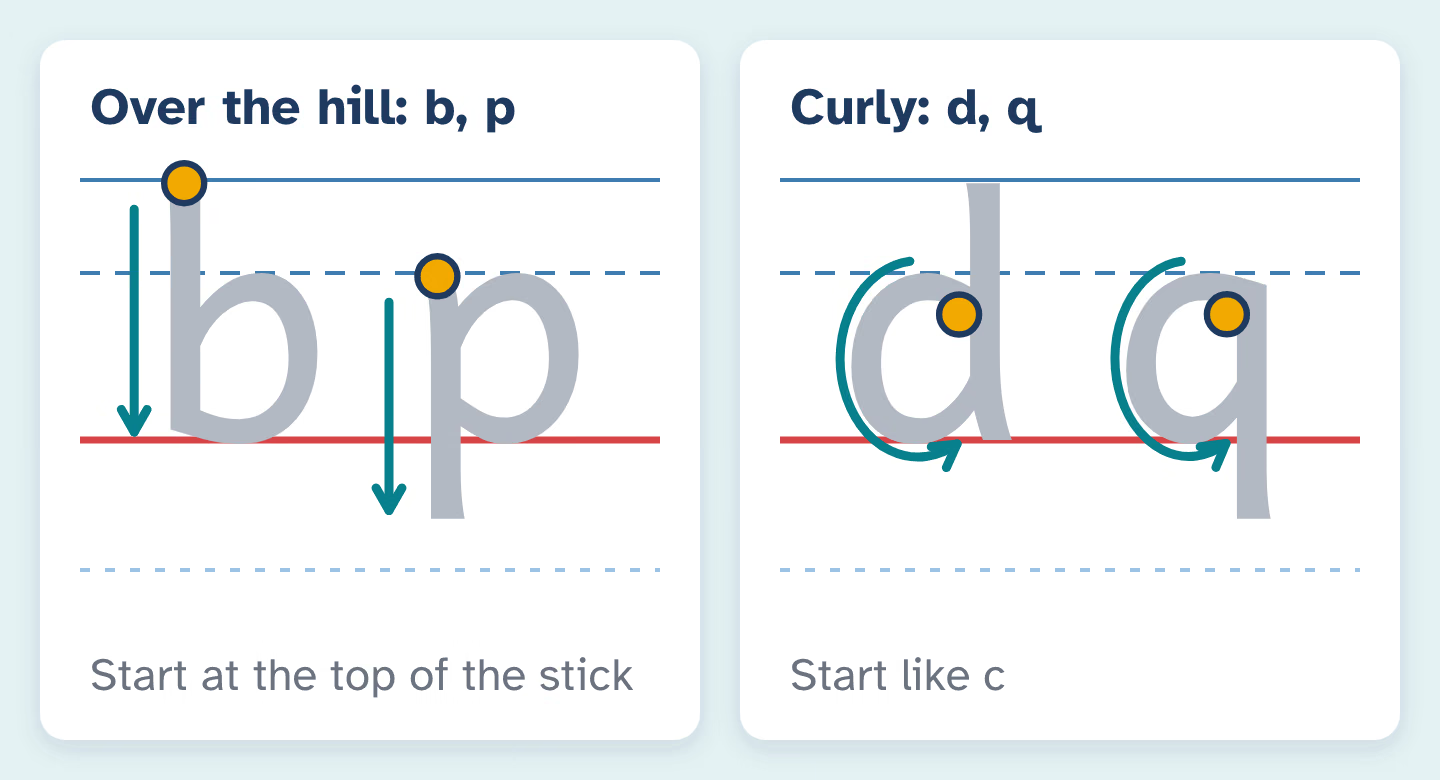
Teaching b and d in different families is a simple way to help children keep them apart. The b belongs with the over-the-hill letters: “tall stick down, back up and round.” The d belongs with the curly letters: “round like a c, then up to the top and down.” They start in different places and move in different directions, so they feel different in the hand even though they look like mirror images. The same trick separates p (over the hill) from q (curly). If reversals are a worry, our guide to letter reversals explains what is normal.
Families for capital letters and numbers
England’s Year 1 curriculum covers capitals and the digits 0 to 9 alongside lowercase letters. Capitals don’t form families as neatly, but grouping by stroke still helps. One handy way:
- Straight lines only: E, F, H, I, L, T
- Slanting lines: A, K, M, N, V, W, X, Y, Z
- Mostly curves: C, G, O, Q, S
- Lines and curves: B, D, J, P, R, U
Numbers group the same way. The 0 and 6 start at the top and curve back around like c, while 1, 4 and 7 are built from straight lines. For practice at home, try our number tracing worksheets.
When it goes wrong
Curly letters go clockwise or start at the bottom. Go back to a big c in the air and say “back round” as your child moves. Then write c, a and d in a row, so the first letter sets up the next.
Over-the-hill letters are built from separate pieces. If your child draws a stick, lifts the pencil and adds a hump, show how the pencil travels back up the line before going over. Slow it right down and say “back up” as it happens.
One letter keeps going wrong. Practise it next to the family’s anchor letter: c for the curly family, n for the hills. The anchor reminds the hand where to begin.
The school forms a letter differently. Follow the school. Both the writing framework and the therapy team note that families vary with the handwriting model a school uses. The NSW Department of Education’s guide for parents, for example, gives each letter a short school-style prompt, such as “around, up, down” for a.
Questions about teaching letters in families
Should I stop teaching the alphabet in order?
Keep the alphabet song and A to Z books for letter names. For handwriting practice, though, families are more efficient than alphabetical order.
How long should we spend on each family?
Until the letters are formed correctly most of the time without a model. Some families settle in a few days and others take longer, so let your child’s writing set the pace.
My child’s school teaches letters through phonics. Is that a clash?
No. Many schools teach phonics and handwriting side by side, each in its own order. Ask which handwriting families the class uses and mirror them at home.
Sources
- Aneurin Bevan University Health Board, Occupational Therapy Service for Children and Young People: Improving Fluency and Correct Letter Formation
- Department for Education (England): The writing framework (2025)
- Department for Education (England): National curriculum, English programmes of study
- NSW Curriculum: English K–10 Syllabus (2022), Early Stage 1 Handwriting
- NSW Department of Education: Handwriting in the early years (guide for parents)
- Steve Graham, “Want to Improve Children’s Writing? Don’t Neglect Their Handwriting,” American Educator (AFT), Winter 2009–2010


