


NSW Foundation Style is the handwriting style taught in New South Wales schools, and it is named in the NSW English K–10 Syllabus. Children learn unjoined Foundation Style letters in Kindergarten, write them from memory with consistent size and slope in Years 1 and 2, and start joining them in Stage 2 (Years 3 and 4). The joined letters keep the same basic shapes, so nothing your child learns in Kindergarten is wasted.
What NSW Foundation Style looks like
NSW Foundation Style has been used in NSW public schools since the late 1980s. The Department of Education describes it as one basic set of letter shapes that serves both young children writing unjoined letters and older students writing joined ones.
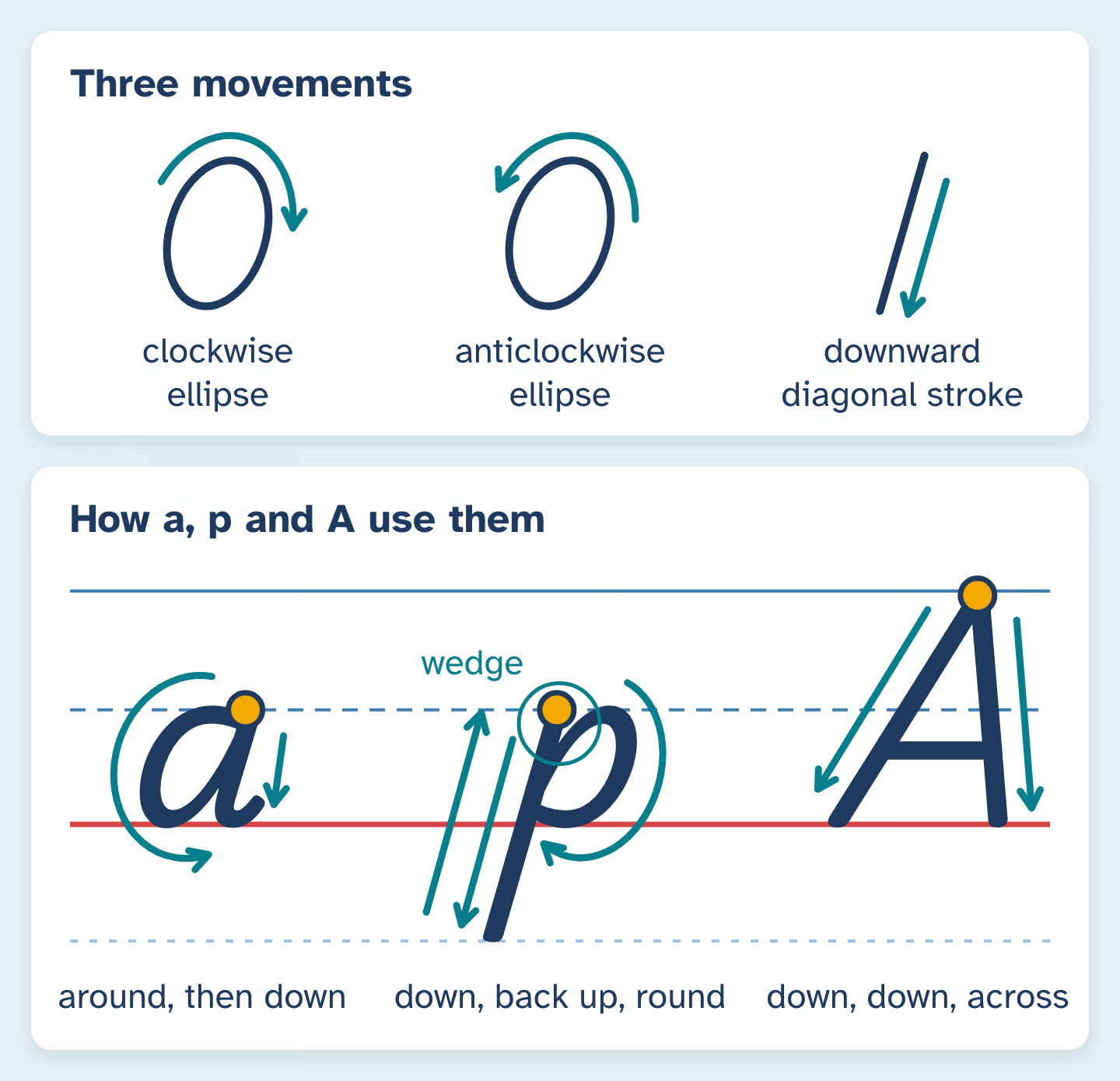
Every letter is built from three movements: a clockwise ellipse, an anticlockwise ellipse and a downward diagonal stroke. That is why the letters look oval rather than perfectly round, and they are written with a slight, consistent slope. The style combines the movements so the pencil comes off the page as little as possible. This helps children keep their size and slope consistent. Small curved corners, called wedges, help the pencil change direction smoothly.
Teachers group the lowercase letters by height:
- Short letters such as a, c, m and s sit in the middle space.
- Tall letters such as b, d, l and t reach up above the middle space.
- Long letters such as g, p and y drop below the line.
A few letters show the style clearly. The a starts at the top, goes around and back to where it started, then the pencil stays on that point and makes a straight line down. The p is a long line down below the baseline, then back up the same line until nearly the top, where the round part branches out and leaves a small wedge at the top. Capital A starts at the top point with two lines down, then a line across to join them.
Kindergarten: forming every Foundation Style letter from the right place
Kindergarten is Early Stage 1 in the NSW syllabus. The handwriting content for this year is practical and physical. Children learn to:
- sit with feet flat on the floor, the writing arm resting on the table, the other hand holding the paper and shoulders relaxed
- use a stable, relaxed pencil grip and the right amount of pressure
- produce the clockwise ellipse, anticlockwise ellipse and downward diagonal stroke inside letter shapes
- form every letter in NSW Foundation Style from the correct starting point and in the correct direction, when the teacher gives a verbal prompt
- use those skills in their own writing.
For children who can’t yet produce handwriting, the syllabus offers other ways to show the same learning. These include finding letters on a keyboard or touch screen, or using speech-to-text.
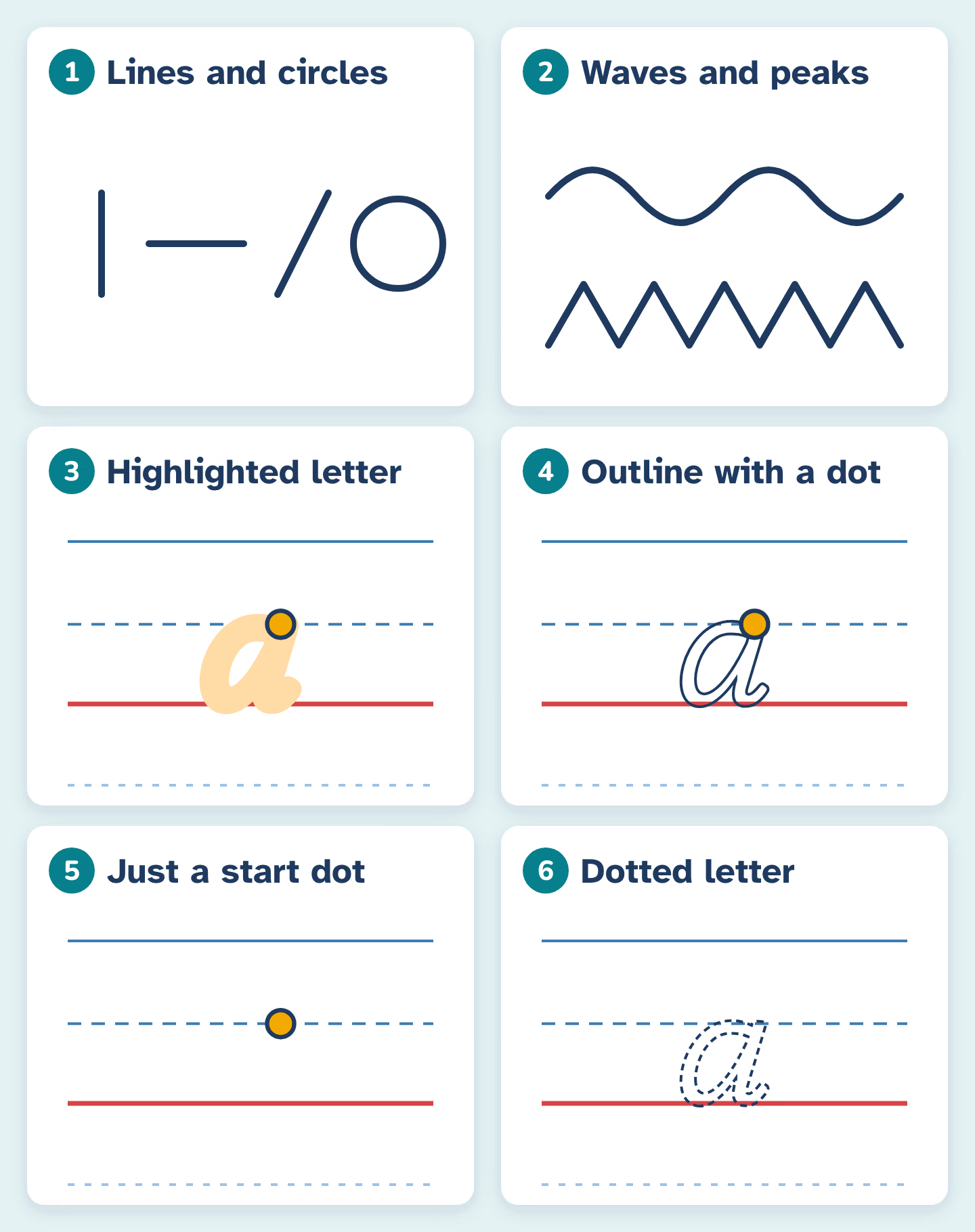
The Department’s parent guide, Handwriting in the early years, describes how teachers build each letter in small steps. Children draw lines and circles, then patterns such as soft waves and pointed peaks. Next they write over a highlighted letter with a dot showing where to start, then use a letter outline with a starting dot, then only a starting dot on a line, and finally a dotted letter. Kindergarten children often use a thicker pencil, and a small dot or sticker on the pencil can show where the fingers go for a tripod grip.
Years 1 and 2: from memory, with size and slope
Stage 1 covers Years 1 and 2. The prompt drops away: the syllabus expects children to form all letters from memory. Letters should have consistent size and slope and sit correctly on the line, with sensible spaces between words. Typing also appears in this stage, alongside handwriting rather than instead of it.
In a Year 1 book, you might still see a few letters started from the bottom or the odd capital in the middle of a word. By the end of Year 2, most children write whole sentences without glancing at the alphabet strip, and the letters lean the same way across the page. Children get there at different speeds, so use these as rough markers rather than deadlines.
What to say while your child writes
The Department’s guide recommends short verbal prompts that can be said in the time it takes to write the letter. Keep them brief and use the same words every time. These work well with NSW Foundation Style:
- a: “Start at the top, around, up and down.”
- d: “Around, up tall, down.”
- n: “Down, back up and over.”
- t: “Down, then across.”
- p: “Down past the line, back up, around and back.”
- s: “Curve one way, curve the other.”
Watch the pencil, not just the finished letter. An a that looks fine on the page may have been drawn clockwise from the bottom, and that habit becomes a problem when joining starts. If you spot it, say the prompt again and write the letter alongside your child.
The lines in NSW books and on printed sheets
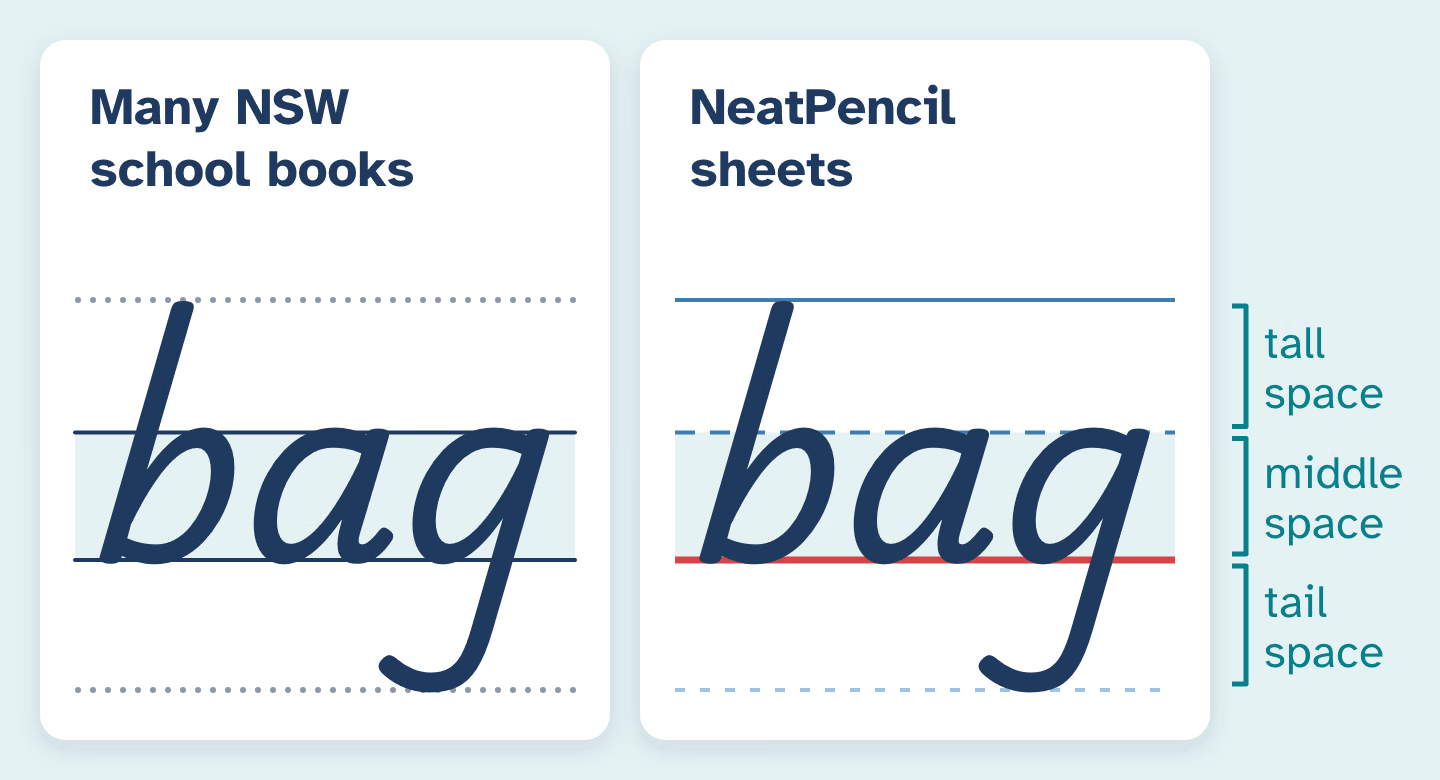
Many NSW handwriting books mark the middle space with two solid lines. A dotted line above is for tall letters, and a dotted line below is for long letters. The Department’s guide describes it that way: short letters touch both solid lines, tall letters stretch up to the top dotted line, and long letters go down to the bottom dotted line.
To practise on the same lines at home, print our free dotted thirds paper: two solid lines around the middle space and a dotted line above and below, in rows of 24, 18, 14 or 12 mm.
Other paper draws the same zones differently. NeatPencil’s NSW Foundation style name tracing worksheets use a top line, a dashed midline, a baseline and a tail line. Short letters sit between the dashed midline and the baseline, tall letters reach the top line, and long letters drop to the tail line. If your child’s school book looks different, point to the zones rather than the line styles: “middle space”, “tall space”, “tail space”.
Joining Foundation Style letters in Stage 2 (Years 3 and 4)
The Stage 2 handwriting outcome is about forming legible joined letters to build fluency. Children join letters in familiar words first, keep their size and spacing consistent while joining, and then use NSW Foundation Style cursive across longer pieces of writing. Because the joined letters grow out of the same shapes, the change is mostly about adding joining strokes, not learning a new alphabet. Schools decide exactly when joins are introduced within the stage, and our guide on when to teach joined handwriting covers the signs a child is ready.
One honest limit of any printed model: the Department has pointed out that computer fonts can’t show every variation of real joined writing. Whether a y needs a joining loop depends on what comes next, and a font has only one y to offer. Printed sheets are good for practice, but your child’s teacher remains the model for joins.
When something goes wrong
- Starting at the bottom. Go back to a starting dot. Put a small dot where the letter begins and have your child trace, then write, from that dot.
- Ovals going the wrong way. Letters such as a, c, d and g start with an anticlockwise movement. Practise big anticlockwise ovals in the air, in sand or on a whiteboard before going back to pencil.
- Letters floating above the line. Ask your child to “sit” each letter on the baseline, and use paper with clear lines.
- Pressing too hard. White knuckles and torn paper suggest too much pressure. Shake out the hand and try a softer, thicker pencil.
- Mixing up b and d. This is common in the first years of school. Our guide to letter reversals explains when it’s normal and what helps.
For extra practice at home, NeatPencil’s letter tracing worksheets can be printed in NSW Foundation style, on A4 or US Letter, with an example row, tracing rows and blank rows. There’s an option for dotted-outline letters, which mirrors the dotted-letter step teachers use. The font is openly licensed and modelled on NSW Foundation Style, but it isn’t the Department’s official font, so compare a page with your school’s chart.
Questions
Is NSW Foundation Style a cursive style?
Not at first. Children write unjoined letters from Kindergarten to Year 2, and the syllabus introduces joined letters in Stage 2 (Years 3 and 4). The joined version uses the same letter shapes.
Should I correct every letter my Kindergarten child writes?
No. Focus on where each letter starts and which way it goes. Wobbly lines and uneven sizes improve with practice; a letter formed backwards is the habit worth catching early.
Why do the letters slope?
A slight forward slope is part of the style’s design, and it carries straight through into joined writing later. The Stage 1 content asks for consistent slope, so a gentle, even lean is the goal rather than a steep one.
My child finds holding a pencil hard. What helps?
Play that strengthens the hands helps more than extra worksheets. Try play dough, pegs, tongs, threading and drawing in sand. Our guides to fine motor activities and pencil grip have more ideas.
Sources
- NESA: English K–10 Syllabus (2022), Early Stage 1 content
- NESA: English K–10 Syllabus (2022), Stage 1 content
- NESA: English K–10 Syllabus (2022), Stage 2 content
- NSW Department of Education: Handwriting in the early years (parent guide)
- NSW Department of Education and Training: NSW Foundation style handwriting information sheet (2009)


